Know what to fix first in AI search


Overview
A brand can rank well in Google and still be absent from AI-generated answers. Traditional SEO reports show rankings, impressions, organic traffic, and conversions. They rarely show how often ChatGPT, Gemini, or Perplexity uses your website as a source or recommends a competitor instead.
This creates a gap in search reporting. Businesses can see which pages attract organic traffic, but they may not know which sources AI platforms reference when buyers research products, compare vendors, or evaluate solutions.
AI citation share measures this visibility against selected competitors. It shows how much of the tracked source-citation activity belongs to your website. Combined with AI brand mentions, citation frequency, and referral performance, it helps SEO teams understand where their content gains visibility and where competitors have an advantage.
The challenge is measuring it correctly. A brand mention isn't necessarily a website citation, and a higher citation count doesn't automatically mean better brand visibility. The reporting method must account for the prompts, platforms, competitors, and sources being monitored.
This blog explains how to calculate AI citation share, track the AI visibility metrics that matter, compare competitors, and build an AI search reporting framework for 2027.
Executive takeaways
- Measure citations separately from mentions. A brand reference without a source link does not establish that your website was used as a source. Track both signals independently.
- Use a consistent calculation method. Define the prompt set, competitor list, platforms, and citation counting rules before calculating AI citation share.
- Prioritize buyer-related prompts. Monitor questions about product capabilities, vendor comparisons, implementation, and purchasing decisions.
- Compare individual AI platforms. Strong visibility in ChatGPT does not guarantee similar performance in Gemini or Perplexity.
- Review the pages receiving citations. A citation to an outdated blog post may be less valuable than one supporting an important product or research page.
- Connect visibility with business performance. Track identifiable AI referrals, branded search demand, qualified leads, and conversions alongside citation metrics.
What should you prepare before starting AI citation tracking?
A citation report is only useful when the monitoring scope reflects how customers research your products and services. A broad collection of unrelated prompts or an inconsistent competitor list can distort the results.
Prepare these inputs before starting:
- Define the reporting objective.
Decide whether you want to improve source citations, identify competitor advantages, increase brand visibility, or evaluate GEO performance. This determines which metrics deserve priority. - Identify buyer questions.
Include product-related searches, industry problems, implementation requirements, vendor comparisons, and purchasing questions. - Separate branded and unbranded prompts.
Questions that already mention your company can inflate visibility figures. Track them separately to understand existing brand demand and new brand discovery. - Select AI platforms.
Choose the platforms relevant to your audience, such as ChatGPT, Google AI Overviews and AI Mode, Gemini, Claude, and Perplexity. - Build a relevant competitor list.
Include businesses competing for the same customers and product categories. Avoid adding unrelated brands simply to increase the comparison set. - Define citation rules.
Decide whether you are counting individual URLs or domain appearances within each response. Document how you handle multiple citations from the same website. - Record a baseline.
Capture current citation share, citation rate, AI brand mentions, and identifiable referral sessions before making optimization changes.
Briskon's AI prompt research guide provides a useful approach to identifying the questions and decision contexts that should shape this research.
How to measure brand visibility in AI search
Measuring brand visibility in AI search requires more than checking whether ChatGPT mentions your company. The process should show where your brand appears, which sources support the answer, and how frequently competitors receive similar references.
Use the following process.
1. Build a buyer-focused prompt set
Start with questions customers ask when identifying a problem, researching a solution, and comparing vendors.
Organize them into five groups:
- Informational: What is the problem or technology?
- Commercial: Which solutions address the requirement?
- Comparison: Which vendors offer similar capabilities?
- Implementation: How does a particular solution work?
- Decision-making: What should a business consider before selecting a vendor?
2. Select the AI platforms to monitor
Choose platforms according to your target audience and industry. ChatGPT, Gemini, Perplexity, Claude, and Google's AI search experiences may be relevant for B2B and SaaS businesses.
Keep platform-level results separate. A combined score can hide situations where your website receives citations on one platform but remains absent from another.
3. Run prompts under consistent conditions
Use the same prompt wording, language, location, and testing conditions across reporting periods wherever possible. AI responses can vary between runs. Repeat important prompts and record the date of each test. This gives you a more reliable basis for comparing results than a single manual check.
Where possible, run tests in signed-out sessions or clean accounts with chat history and memory turned off. Signed-in accounts, saved preferences, and personalization features can change which sources an AI platform cites, making results harder to compare.
4. Record citations and AI brand mentions
Capture the complete response, cited URLs, source domains, brand references, and competitor names.
For each response, record:
- Whether your brand appears.
- Whether your website is cited.
- Which page or domain is referenced.
- Which competitors appear.
- Whether the information about your business is accurate.
5. Identify the sources competitors receive citations from
Review the pages and domains that appear repeatedly in competitor responses. Look for industry publications, research reports, comparison websites, review platforms, and expert articles. If a competitor's product is frequently supported by third-party reviews while your brand relies mainly on its own website, that is an authority gap worth investigating.
6. Compare results by topic and platform
Calculate citation share for individual product categories, industry subjects, and AI platforms. A software company may receive citations for general educational questions but remain absent from vendor comparisons.
7. Connect visibility data with website performance
Review identifiable AI referral sessions, landing-page engagement, conversions, and branded search demand alongside citation data.
Branded search growth can support the case that AI visibility is improving brand discovery, but it does not prove that AI citations caused the increase. Compare these trends over several reporting periods and review other marketing activities that may have influenced demand.
Understanding how AI search makes decisions also helps explain why different platforms may select different sources for similar questions.
Which AI visibility metrics and AI search KPIs should you report?
AI citation share is an important measure, but it should not be the only KPI in your report. A useful framework combines source visibility, brand representation, citation quality, and business performance.
| AI search KPI | What to measure | Why it matters |
|---|---|---|
| AI citation share | Your percentage of qualifying citations against tracked competitors | Shows relative source visibility |
| AI citation rate | Percentage of valid responses citing your website | Measures how frequently your content is referenced |
| AI brand mentions | Responses referencing your brand, with or without links | Measures brand recognition |
| Citation quality | Relevance, accuracy, and context of cited pages | Shows whether citations support the right information |
| AI share of voice | Relative brand visibility using the selected tool's methodology | Shows competitive visibility trends |
| AI referral traffic | Sessions from identifiable AI platforms | Measures website visits from AI discovery |
| AI-assisted conversions | Leads and conversions associated with AI referral journeys | Connects visibility with business outcomes |
Track these KPIs consistently across the same AI platforms, prompt sets, competitors, and reporting periods to identify meaningful performance changes. For another perspective on AI visibility metrics, review the metrics and measurement definitions used in Semrush's AI Visibility Toolkit.
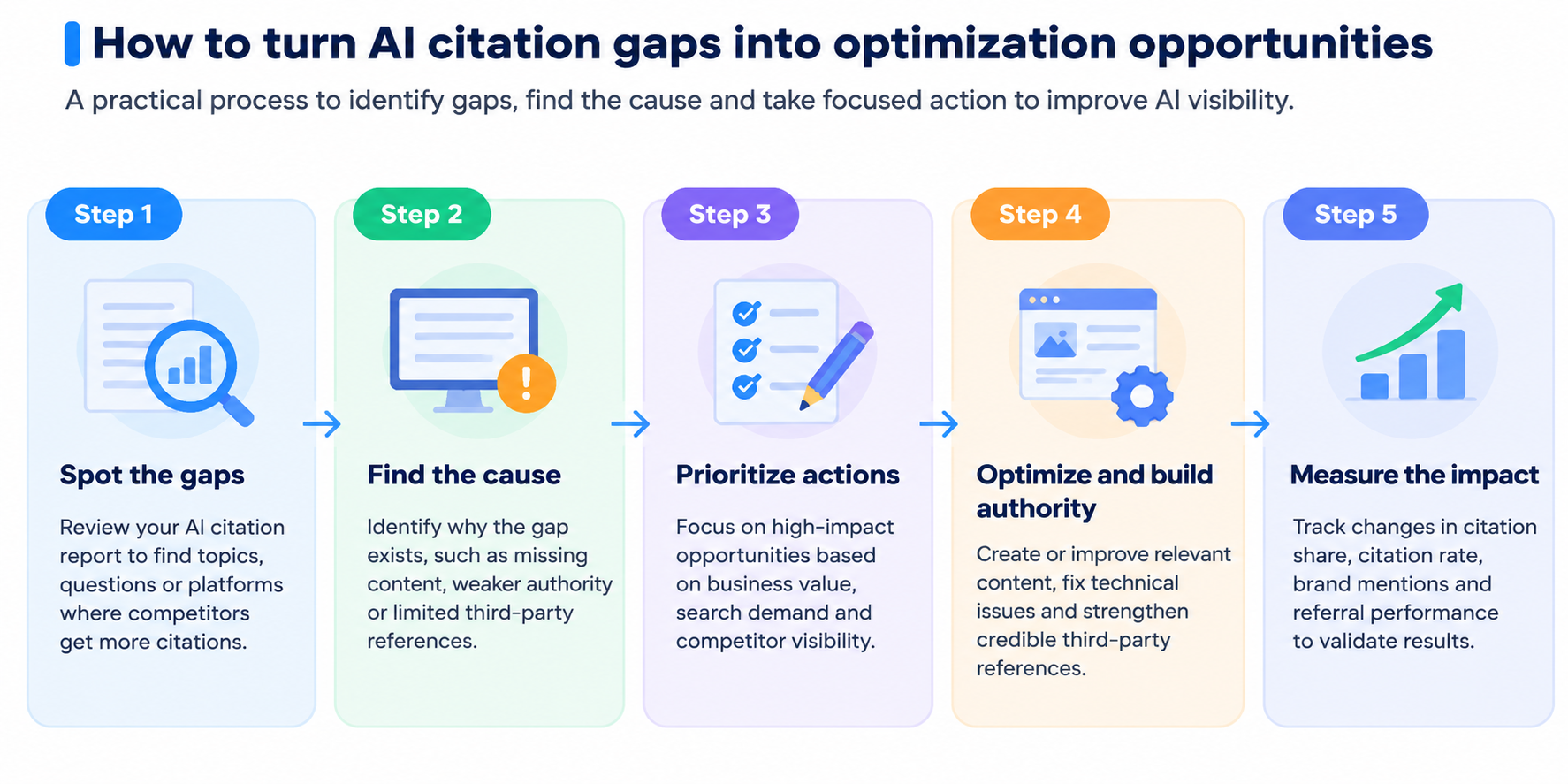
How to turn AI citation gaps into optimization opportunities
A competitor receiving more citations does not automatically mean your website needs more content. First, identify the pages, topics, and external sources influencing those answers.
| What the report shows | Possible reason | Recommended action |
|---|---|---|
| Competitors receive citations, but your brand is absent | Missing content coverage or weaker external authority | Develop relevant content and strengthen credible third-party references |
| Your brand is mentioned without a website citation | AI recognizes your brand but does not consistently reference owned content | Improve source clarity and publish useful, evidence-backed information |
| Your website receives citations for outdated information | Product or service pages contain old details | Update the affected pages and supporting information |
| Citation share is strong for some topics but weak for others | Uneven topical coverage | Prioritize gaps in commercially important topics |
| Citations appear on one platform but not others | Differences in platform retrieval and source selection | Review platform-specific content and prompt gaps |
| Competitors receive more citations from industry publications | Stronger external corroboration | Invest in original research, expert contributions, and relevant digital PR |
Three areas deserve particular attention.
Strengthen content that deserves citations
Pages containing original research, verified product information, expert explanations, and useful comparisons provide information that other sources can reference.
Build content around the questions customers ask when evaluating solutions. Include product specifications, implementation details, industry evidence, and clear comparisons where relevant.
A focused GEO strategy helps connect content depth, brand authority, and external references to the topics where your business needs greater visibility.
Improve technical accessibility and source clarity
A useful page still needs to be accessible. Review crawling, indexing, rendering, structured information, and internal linking to ensure important content can be discovered.
A technical SEO assessment can identify problems affecting content accessibility. Also review publication dates, authorship, product details, and the accuracy of important commercial pages.
Build authority beyond your website
AI visibility does not depend only on your own content. Industry publications, research platforms, review websites, and credible third-party sources can influence how your brand is represented.
Identify which external sources appear in competitor answers and where your business can contribute useful information. Original research, expert commentary, case studies, and relevant digital PR are more valuable than pursuing mentions on unrelated websites.
For businesses that need specialist support, Briskon's GEO services focus on brand authority, AI discoverability, and citation opportunities. Its AEO services address answer visibility, prompt research, and content improvements.
These activities can also form part of a broader AI SEO strategy that connects technical optimization, content, and authority building.
AI citation reporting mistakes that should trigger a review
A report can show an improvement even when underlying visibility hasn't changed. Review these mistakes before using citation share to evaluate performance.
- Counting mentions as citations.
A brand name appearing in an answer does not mean its website was cited. Keep linked source references and unlinked mentions separate. - Using an unclear denominator.
State whether the calculation counts domain appearances, individual URLs, or responses containing citations. - Mixing branded and unbranded prompts.
Questions that already include your company name can inflate visibility and hide gaps in new brand discovery. - Changing the prompt set between reports.
Adding prompts where your brand already performs well can increase the percentage without improving visibility across the original set. - Relying on isolated responses.
AI answers vary. Repeat important prompts before concluding a trend. - Combining all platforms into one number.
A strong result on one platform can hide weak visibility on another. Keep platform-level results available. - Ignoring citation quality.
A citation supporting outdated or incorrect information should not be treated as a successful outcome. - Treating citation growth as revenue growth.
More citations may improve exposure, but commercial impact requires separate referral, conversion, and CRM analysis. - Using universal benchmarks.
A 20% citation share means different things depending on the number of competitors, the prompt set, and the industry.
Final thoughts
AI citation share adds another dimension to SEO reporting. It shows how frequently AI platforms use your website as a source compared with competitors, helping businesses understand visibility beyond traditional rankings and clicks. But the percentage alone does not explain why your brand is gaining or losing citations.
Track the pages being referenced, review how AI platforms describe your business, and compare results across the same prompts and competitors. Most importantly, connect visibility changes with branded search demand, referral activity, and qualified opportunities. The objective is not to collect more citations. It is to become a useful and credible source for the questions that influence buying decisions.
Frequently asked questions
What is AI citation share?
AI citation share is the percentage of qualifying source-domain citations attributed to your website compared with the total citations received by your website and selected competitors. It measures relative source visibility across a defined set of prompts and AI platforms.
How do you calculate AI citation share?
Divide your website's qualifying citations by the total qualifying citations received by your website and selected competitors, then multiply by 100. Keep the prompt set, platforms, competitor list, and citation counting method consistent.
What is the difference between AI citation share and AI share of voice?
AI citation share measures your proportion of source citations within a defined competitive set. AI share of voice measures relative brand visibility in AI responses and may use brand mentions or estimated impressions, depending on the tool. The two metrics should not be treated as interchangeable.
What is AI citation rate?
AI citation rate measures the percentage of valid AI-generated responses that cite your website at least once. Unlike AI citation share, it does not compare your citations with competitors. It measures how frequently your own domain appears as a cited source.
How often should businesses track AI citations?
Review prompt-level citation data weekly or at an agreed monitoring cadence, and prepare a consolidated report monthly. Repeat important prompts and maintain the same measurement scope when comparing reporting periods.
Can AI platforms mention a brand without citing its website?
Yes. AI platforms can discuss a company, product, or service without linking to its website. These references count as AI brand mentions rather than website citations. Tracking both helps businesses understand brand recognition and source visibility separately.
What is a good AI citation share?
There is no universal benchmark. A meaningful target depends on your industry, competitor set, prompt selection, and AI platforms. Establish a baseline and measure progress against relevant competitors using the same methodology.
Which tools can help with AI citation tracking?
Platforms such as Ahrefs Brand Radar, Semrush's AI Visibility Toolkit, and specialist AI visibility platforms offer citation, mention, and competitor monitoring capabilities. Structured manual prompt testing can also help validate important findings. Compare the tools' definitions and sampling methods before combining their data.
Does a higher AI citation share guarantee more website traffic?
No. AI-generated answers can influence brand awareness and buying decisions without producing a website visit. Track identifiable AI referral sessions, conversions, branded searches, and qualified leads alongside citation share to understand its business contribution.
Understand where your brand stands in AI search
Partner with Briskon and strengthen your brand authority across AI-powered search platforms.
Contact us today