
ON THIS PAGE
- Overview
- What are ATL, BTL, and TTL in simple terms
- What is ATL (Above The Line) in marketing?
- What is BTL (Below The Line) in marketing)
- Understanding TTL (Through The Line) in marketing
- Key differences between ATL, BTL, and TTL
- How Briskon approaches ATL, BTL, and TTL for enterprise brands
- 1. Strategic clarity: One story across every channel
- 2. AI-era readiness: Designed for AI discovery and buyer evaluation
- 3. Revenue alignment: One leadership-ready growth narrative
- 4. Execution depth: Orchestration across the full go-to-market stack
- Final thoughts
Make your ATL, BTL, and TTL work as one.

The marketing landscape is evolving quickly, leading to a crucial question: where should we invest our resources for the greatest impact? Should we focus on brand building, performance marketing, or a balanced strategy that combines both? As Philip Kotler noted, “Marketing takes a day to learn. Unfortunately, it takes a lifetime to master,” highlighting the need for continual strategy assessment to achieve lasting success.
In this context, the concepts of ATL (Above The Line), BTL (Below The Line), and TTL (Through The Line) are essential. They provide marketing leaders with the clarity and confidence to make informed decisions about media and channels.
In this blog, we will define ATL, BTL, and TTL, explore their roles in digital-first strategies, and show how decision-makers can use these concepts to create a more balanced and predictable marketing approach.
What are ATL, BTL, and TTL in simple terms
Before going into depth, here is a simple way to look at them:
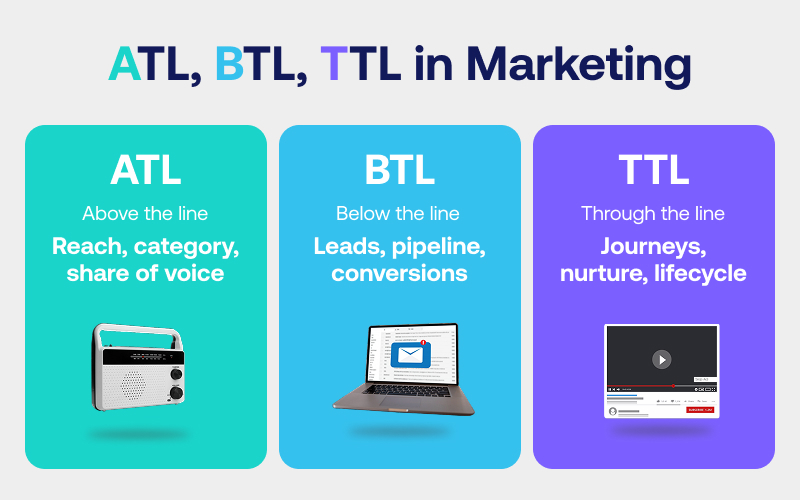
- ATL (Above the line): Large-scale, mass reach campaigns that build awareness, salience, and brand recall across broad audiences.
- BTL (Below the line): Targeted, focused marketing that nurtures specific segments, drives measurable actions, and moves people closer to purchase.
- TTL (Through the line): An integrated approach that blends ATL and BTL, using one unified idea and measurement framework across brand and performance touchpoints.
Think of ATL as creating visibility at scale, BTL as converting interest into action, and TTL as orchestrating both as a single system.
What is ATL (Above The Line) in marketing?
ATL plays a crucial role in various industries by concentrating on specific key areas. Understanding ATL not only highlights its importance but also sheds light on how it contributes to overall success and innovation.
ATL focuses on:
- Building brand awareness and mental availability
- Shaping perception in the minds of large audiences
- Reaching potential buyers early in their journey
- Creating emotional and strategic positioning that future campaigns can build on
Common ATL channels
In the traditional and digital world, ATL includes:
- Television advertising and OTT sponsorships
- Radio and audio platforms
- Print campaigns in newspapers and magazines
- Outdoor and out-of-home (OOH) – hoardings, billboards, transit media
- High-impact digital placements – home page takeovers, YouTube mastheads, programmatic reach campaigns, publisher roadblocks
- Large-scale social media awareness campaigns with broad targeting
How to know if ATL is the right choice
For B2B, SaaS, and enterprise brands, above-the-line (ATL) marketing is effective when:
- You want to establish or refresh positioning in a new market or region
- You are launching a new brand, category, or product, and want immediate visibility
- You operate in a competitive category where top-of-mind recall shapes RFP lists or vendor shortlists
- You want to support your sales teams with strong brand air cover in priority geographies
ATL gives you reach, familiarity, and a consistent story at scale. It makes every later performance campaign more efficient because people already recognise and trust you.
What is BTL (Below The Line) in marketing
BTL focuses on highly targeted, personalised touchpoints that turn awareness into measurable actions. Understanding BTL shows how focused campaigns nurture specific segments, improve conversions, and deepen customer relationships.
BTL goes deep instead of wide. It focuses on:
- Targeting specific segments or accounts
- Driving actions – signups, demos, trials, meetings, downloads
- Nurturing leads with relevant content and experiences
- Delivering measurable, attributable outcomes
Common BTL channels
In modern marketing, BTL includes:
- Email marketing and marketing automation nurture
- Landing pages, lead magnets, and gated assets
- Webinars, workshops, and virtual events
- Field marketing and account-based events
- Direct mail and personalised gifting for key accounts
- Sales enablement content, sequences, and one-to-one outreach
- Performance campaigns on Google, LinkedIn, Meta, and programmatic platforms with targeted segments
- In-app messages, product tours, and lifecycle campaigns for SaaS products
Where BTL creates the strongest conversion leverage
BTL (Below The Line) marketing becomes essential when businesses aim to effectively engage specific target audiences and create personalized interactions that enhance customer loyalty.
- You have clearly defined ICPs, target accounts, and buyer personas
- Your sales cycle is multi-stage and complex
- Your goal is to drive qualified demand — not just website traffic
- You need clear attribution to pipeline, revenue, and retention
In B2B and SaaS, BTL is where marketing and revenue teams interact deeply. It connects brand interest to pipeline impact.
Understanding TTL (Through The Line) in marketing
TTL acts as the essential link between ATL (Above The Line) and BTL (Below The Line) marketing strategies. By integrating these approaches, TTL ensures cohesive and effective communication across all marketing channels.
It ensures that:
- Brand and performance work come from a unified strategy — not separate silos
- Creative themes and messaging stay consistent from awareness through conversion
- Insights from BTL campaigns inform ATL planning — and ATL fuels BTL performance
- Customers experience one seamless story, no matter where they interact with your brand
Strategic scenarios where TTL works best
TTL strategies are particularly effective in certain scenarios:
- Launching new products: When introducing new solutions, TTL can create buzz and drive immediate interest among potential buyers.
- Targeting niche markets: For specialized offerings, TTL helps in reaching specific audiences more effectively.
- Building brand loyalty: Engaging existing customers through TTL can foster loyalty and encourage repeat business.
- Maximizing lead conversion: When the goal is to convert leads into customers quickly, TTL provides a cohesive approach to guide them through the sales funnel.
- Enhancing customer experience: By integrating multiple touchpoints, TTL creates a seamless experience that can improve customer satisfaction and retention.
Key differences between ATL, BTL, and TTL
Let’s break it down side-by-side:
| Category | ATL | BTL | TTL |
|---|---|---|---|
|
Objective |
Build brand awareness, shape perception, and create salience at scale.
|
Drive specific actions, nurture intent, and generate measurable pipeline or revenue outcomes. |
Orchestrate both brand and performance within a single unified framework so that every touchpoint supports long-term equity and short-term results. |
|
Targeting |
Broader, sometimes demographic or interest-based, often less granular. |
Highly specific – by account, role, behaviour, region, or funnel stage. |
Starts broadly at the top and progressively narrows down, guided by data from each stage. |
|
Measurement |
Measures brand metrics – reach, impressions, share of voice, brand lift, search lift, recall, and consideration. |
Measures performance metrics – leads, MQLs, SQLs, meetings booked, trials started, opportunities, revenue, CAC, and LTV. |
Measures the journey – from awareness to revenue – and focuses on combined KPIs such as cost per qualified opportunity, pipeline velocity, and marketing-sourced or influenced revenue. |
|
Time horizon |
Primarily long-term – builds momentum that compounds over months and years. |
Often mid- to near-term – shows impact on pipeline and revenue over weeks and quarters. |
Balances both – designs campaigns where short-term performance contributes to long-term brand strength. |
|
Creative style and messaging |
Story-driven, emotional, memorable, and simple enough for broad audiences. |
Specific, value-centric, solution-focused, and often more detailed. |
Keeps one core narrative while adapting depth and format for each stage of the journey. |
How Briskon approaches ATL, BTL, and TTL for enterprise brands
At Briskon, ATL, BTL, and TTL operate as one growth system that compounds visibility, demand, and revenue outcomes across the whole buyer journey. We architect this system through Briskon’s UnifiedOSS (Unified Organic Search Suite), which connects brand presence, performance execution, and lifecycle experiences into a single operating model for modern enterprise marketing.
1. Strategic clarity: One story across every channel
We build a shared strategic foundation so every touchpoint reinforces the same market signal.
- Clear ICP and buying-committee mapping across economic buyers, technical evaluators, champions, and procurement
- A value-proposition hierarchy that stays consistent from awareness to conversion
- A strong category narrative and positioning that attracts attention and builds preference
- A message architecture that translates into creatives, offers, landing pages, and scalable content systems
Result: ATL recognition, BTL response, and TTL progression speak one language across every surface.
2. AI-era readiness: Designed for AI discovery and buyer evaluation
Enterprise buyers increasingly research inside AI overviews, answer engines, and generative interfaces before they ever complete a form. We align each marketing layer to perform within these discovery environments.
- ATL builds brand strength — reinforcing your entity, category relevance, credibility, and authority
- BTL turns intent into action — leveraging high-intent search, paid social, ABM, retargeting, and precision offers
- TTL connects the journey — using stories, comparisons, proof assets, ROI narratives, and enablement content to guide decisions
UnifiedOSS ensures your content, landing experiences, schema, and authority signals remain aligned so AI systems and human buyers interpret your brand with clarity and confidence.
3. Revenue alignment: One leadership-ready growth narrative
We connect brand and performance into a single revenue model that leadership teams can review confidently.
- ATL measures: category reach, share of voice, brand search lift, direct traffic lift, engagement quality
- BTL measures: pipeline sourced, pipeline influenced, CAC efficiency, conversion rates, velocity contribution
- TTL measures: stage progression, nurture-to-SQL lift, expansion readiness, retention support through education, and product adoption content
Briskon’s UnifiedOSS provides a consolidated performance view, so brand momentum and pipeline contribution appear as a single compounding system.
4. Execution depth: Orchestration across the full go-to-market stack
We execute with an orchestration mindset, so channels move in sync and reinforce each other.
- SEO, AEO, and GEO to engineer presence across search and generative discovery
- PPC and paid social to capture demand, accelerate testing, and scale winning narratives
- Content and creative systems to operationalize category storytelling at enterprise cadence
- CRO and web experience to convert intent into qualified meetings and opportunities
- Automation and lifecycle journeys to sustain momentum and accelerate stage movement
UnifiedOSS acts as the coordination layer that keeps strategy, content, channels, and conversion experiences aligned.
Final thoughts
When you design your marketing with all three in harmony- brand equity, qualified demand, and revenue growth start reinforcing each other instead of competing for budget.
If you want to structure your marketing around a modern ATL–BTL–TTL model that reflects how buyers actually discover, evaluate, and decide in the AI era, Briskon can help you design and run that system end to end.
Turn your ATL, BTL, and TTL strategy into one unified growth system that balances brand and performance.
Let Briskon design integrated campaigns that connect awareness, demand, and revenue across your key channels.
Contact us today
