
ON THIS PAGE
Be the answer Google AIO chooses first


"The future of search celebrates meaning over mechanics and insight over indexing."
Welcome to the AI-powered search era
Let's start with a question many marketers and CXOs are now asking: What happens to traditional SEO when Google starts answering queries itself?
Google's AI Overviews (AIO) represents a pivotal advancement. It's a monumental shift in how people discover information, evaluate brands, and make buying decisions. As someone deeply entrenched in the marketing trenches, Google AIO is viewed as a technology update; it is a complete reimagination of content consumption, relevance, and visibility.
This blog unpacks Google AIO from a strategic lens. What it means for your brand, how it changes the rules of discoverability, and how to optimize for this AI-led environment without losing your brand's voice in the process.
What is Google AIO (AI Overviews)?
Google AIO, or AI Overviews, is an intelligent layer in Google Search that provides concise, AI-generated summaries for user queries directly on the SERP (Search Engine Results Page). Instead of listing blue links and featured snippets alone, AIO distills top content sources and presents a synthesized answer to the user's question. These answers are generated by large language models (LLMs) trained on Google's vast index of the web.
Instead of competing for rank, we’re now competing for inclusion in answers, prompts, and LLM citations. That’s where AEO, AIO, and GEO converge, each tackling a different layer of visibility.
Key highlights:
- AIO is dynamic and query-sensitive.
- It cites multiple sources, but in a non-traditional, non-click-heavy format.
- It prioritizes relevance, coherence, and authority, not just keyword matches.
Google AI Overview features
Google’s AI Overview feature reshapes how we experience search. Rather than just showing a list of conventional SERP links,it delivers a smart, AI-generated summary right at the top, saving time and offering clarity in a single glance. Powered by Google’s Gemini model, this feature gathers insights from credible sources across the web and weaves them into a clear, concise answer that actually makes sense. It’s like having a knowledgeable assistant who quickly summarizes everything you need to know, before you even think about clicking.
Key characteristics of Google AI Overview include:
- Summarized responses: Users receive a complete, well-structured answer without needing to click into multiple pages.
- Multi-source citations: AI Overviews pull insights from several authoritative websites, offering a more comprehensive perspective.
- Semantic understanding: It interprets user intent beyond exact-match keywords, favoring contextual and conversational phrasing.
- Visual enhancement: AI Overviews may include images, carousels, and other rich media to support the answer experience.
The Google AI Overview feature significantly enhances search efficiency, shaping how users engage with content and how brands appear to their audience.
How does Google AIO work? (The anatomy of an overview)
Google AIO is powered by its Gemini model, a large language model (LLM) designed to synthesize information at scale. It crawls and interprets billions of web pages, semantically matches them to user queries, and delivers a unified, intelligent response on the SERP.
Here's what Google AIO looks for:
- Semantic context: It evaluates meaning and intent over surface-level keyword repetition, prioritizing content that mirrors how users ask questions.
- Structured signals: It analyzes schema markup, content architecture, metadata hierarchies, and internal linking to determine topical depth and clarity.
- Authority indicators: It applies the E-E-A-T model—Experience, Expertise, Authoritativeness, Trust—to assess whether a page is credible and authoritative in its domain.
- Prompt probability: It determines how likely a page is to be chosen for inclusion in a generated answer, based on its clarity, completeness, and consistency across platforms.
AIO output = Credible sources + Contextual intelligence + Summarized delivery.
This means that instead of ranking links, Google is orchestrating narratives. For marketers, the implication is profound: you must write for humans with nuance while structuring for machines with precision. Success comes from alignment with LLM behaviors, not just algorithmic hacks.
Google Search AI Overview: Impact on SEO
Google Search’s AI Overviews fundamentally recalibrate how SEO operates. While traditional SEO focuses on visibility through rankings and link structures, AI Overviews prioritize semantic relevance, structured context, and citation worthiness. The impact extends beyond technical optimization. It reshapes how content is conceived, formatted, and distributed.
Key impacts include:
- Decreased traditional click-through rates: You heard it right. AI Overviews often answer user queries directly, thereby reducing the need for clicks to traditional organic listings. Traffic is no longer the only success metric—brand inclusion within summaries holds measurable value.
- Higher value on authority and trust: Google favours content from authoritative, expert sources to populate its AI responses.
- Content formatting transformation: SEO content must evolve into answer-ready formats, including FAQs, definitions, and bullet-rich breakdowns.
- Visibility shift to AI summaries: Your brand's exposure now depends on being cited or referenced in AI-generated summaries—not just ranking in the top 10 results.
- Shift from keyword targeting to topic authority: SEO success now hinges on deep, entity-driven content that satisfies specific intents.
- E-E-A-T signals are critical: Expertise, authoritativeness, and trustworthiness are core signals AIO uses for sourcing content.
- Multimodal SEO becomes relevant: AI Overviews pull from text, images, and even videos—requiring optimisation across multiple formats.
- Greater impact of structured data: Schema markup helps Google understand and extract content for AIO more efficiently.
- Entity-based SEO gains importance: Google’s AI relies heavily on entity relationships—optimising for known entities can improve inclusion.
- Intent matching over keywords: Semantic understanding is key; content must align with user intent rather than exact keyword matching.
To stay relevant, SEO strategies must now integrate AI alignment into every layer—from content planning to performance measurement. Brands that adapt early to AIO’s influence will shape search outcomes, not just respond to them.
AIO vs Traditional SEO: What changes?
Let’s break it down side-by-side:
| Feature | Traditional SEO | Google AIO |
|---|---|---|
|
Focus
|
Keywords & backlinks |
Semantic intent & entity strength |
|
Visibility |
SERP listings |
AI-generated summaries |
|
Traffic goal
|
Click-through rate |
Citation & brand mention |
|
Optimization |
Meta, headers, keywords |
Schema, narrative, trust signals |
|
Measurement |
Rank & CTR |
Inclusion & influence in AI response |
The core pillars of SEO — discoverability, content relevance, and structured delivery —remain as vital as ever. What has transformed is where that optimization leads. Google AIO elevates the destination from simple link visibility to intelligent inclusion within AI-generated conversations.
This evolution prioritizes meaningful depth over superficial volume, structured clarity over keyword repetition, and credibility over mechanical tactics. It recognizes and rewards brands that create with purpose; content that educates, resonates, and aligns with how users seek answers today. SEO continues to thrive, now redefined through the lens of intelligent summarization and AI-first relevance.
How to rank in Google AI Overview
Earning placement in Google’s AI Overviews requires a strategic departure from conventional SEO. It demands a hybrid approach where machine readability, topical authority, and semantic clarity converge. Ranking in AI Overviews is not about algorithm gaming. It’s about proving consistent value, structure, and trustworthiness.
Here’s how to position your brand for inclusion:
- Elevate content precision: Answer specific, high-intent questions clearly. Create content that addresses queries the way users actually speak or search.
- Use structured data intelligently: Implement schema markup across all content types—FAQs, how-tos, articles—to provide machines with a defined understanding of your content.
- Build semantic depth: Organize your content into well-connected topic clusters that reinforce authority around key entities and themes.
- Amplify E-E-A-T signals: Display contributor credentials, cite third-party recognition, and maintain transparency across content and authorship.
- Optimize for citation logic: Ensure your content is referenced by reputable platforms and aligns with frequently cited domains in your niche.
- Audit AI visibility: Test prompts using tools like Gemini and Perplexity to understand how your brand performs across AI environments.
Ranking in Google AI Overview means aligning your content with LLM cognition and Google’s evolving trust architecture.
Why AIO deserves a front-row seat in your growth strategy
Leading growth? Here’s what an AIO-optimized presence unlocks:
- AI Overviews are now the first impression: Google’s AI-generated summaries often appear above traditional results, making them prime real estate for brand visibility.
- They capture high-intent decision moments: AIO surfaces answers, not just links—putting your brand directly in front of users when decisions are being made.
- Traditional SEO alone is no longer enough: Being on page one does not guarantee inclusion in AI Overviews. Optimisation for AIO is a distinct, necessary layer.
- Trust and authority drive inclusion: Google prefers content from brands with strong E-A-T signals—positioning trusted voices as the default answer.
- AIO is built for speed and summarised discovery: Buyers are scanning less and expecting faster clarity. AIO meets this need, and your content must match its structure and precision.
- It shapes voice and generative search too: AI Overviews influence how voice assistants and LLMs, such as ChatGPT and Gemini, respond, impacting discovery beyond Google.
- Being featured builds brand leadership: Brands that consistently appear in AI Overviews signal authority, innovation, and relevance in their category.
- It aligns with future-proof SEO: Investing in AIO means preparing your brand for how search is evolving, not chasing yesterday’s ranking signals
How to optimize for Google AIO (Actionable roadmap)
Google redefines search with AI Overviews, setting a new standard for intelligent discoverability. In this AI-first era, optimization focuses on aligning content with how machines interpret, prioritize, and present meaningful insights. Success now means being part of the conversation, not just listed on the page.
Below is a strategic and tactical roadmap to elevate your brand within Google’s AI Overviews:
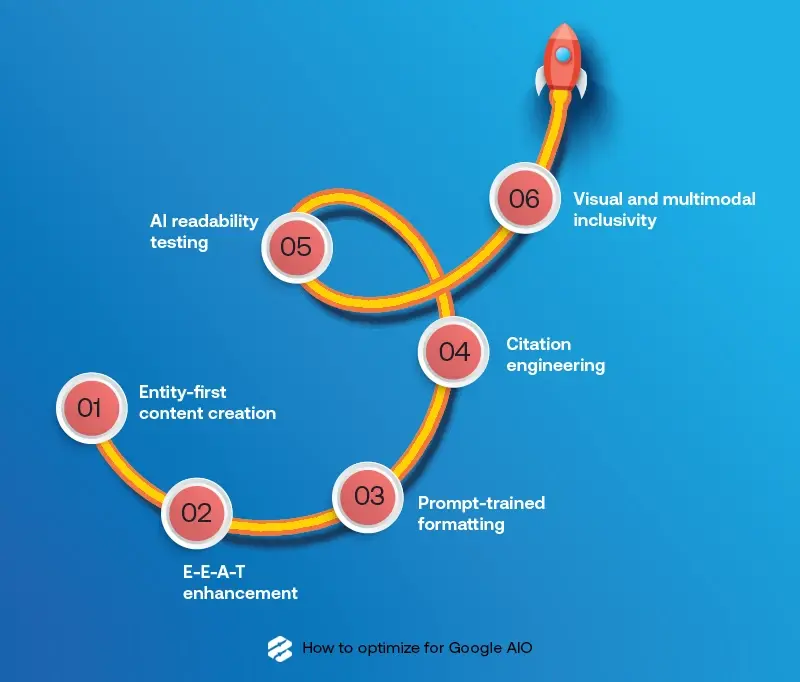
- Entity-first content creation
- Focus on semantic clusters, interlinked topic pages, and contextual depth that signals expertise.
- Implement structured data using the schema.org vocabulary to help machines accurately decode your content.
-
E-E-A-T enhancement
- Build trust by highlighting credentials, expert author bios, and third-party citations.
- Showcase testimonials, reviews, and authoritative backlinks to demonstrate authenticity.
- Prompt-trained formatting
- Reformat pages to match how users ask questions: use FAQs, listicles, and direct-answer structures.
- Organize content using clear headers, concise bullets, and numbered formats that AIO can parse with ease.
- Citation engineering
- Align with domains frequently cited in AIO by linking, collaborating, or getting referenced.
- Distribute your content across high-authority platforms and maintain consistent brand signals across the web.
- AI readability testing
- Regularly test your visibility across AI interfaces like Perplexity, Bing Copilot, and Gemini.
- Simulate high-intent prompts to observe how and when your brand appears in AI-generated responses.
- Visual and multimodal inclusivity
- Embed context-rich visuals like diagrams, infographics, and data visualizations that AI can interpret.
- Ensure accessibility across devices, formats, and channels, enhancing the value and reach of every content asset.
AIO optimization represents a strategic leap forward. Strategic alignment with AI Overviews secures brand relevance, establishes trust, and enhances discoverability. From crafting thought-led content to optimizing landing pages for AI inclusion, every brand can confidently lead in this new search layer where intelligent engines spotlight the most authoritative voices.
Ranking in Google AI Overview starts with the right strategy
See how Briskon's AI-first SEO puts your brand in the spotlight of modern search
Contact us today !
Google AI Overview vs ChatGPT
While both Google AI Overview and ChatGPT are powered by large language models, they serve distinct purposes within the evolving AI ecosystem. Understanding the differences between the two helps brands better tailor their content strategies.
Key differences:
- Purpose and intent:
- Google AI Overview is integrated into the search engine, providing instant answers based on live indexing of web content.
- ChatGPT functions as a conversational assistant, offering generative responses based on a combination of training data and user prompts.
-
Source of information:
- Google AI Overview relies on real-time data and actively crawls web pages.
- ChatGPT is trained on historical datasets and does not access real-time content unless integrated with plugins or web access.
- Citation and attribution:
- Google AI Overview includes source citations, offering transparency and credibility.
- ChatGPT typically does not cite specific sources unless prompted to do so.
- Use cases:
- Google AI Overview supports immediate information retrieval for search queries.
- ChatGPT supports open-ended tasks like drafting, brainstorming, and multi-turn conversations.
AIO optimization represents a strategic leap forward. Strategic alignment with AI Overviews secures brand relevance, establishes trust, and enhances discoverability. From crafting thought-led content to optimizing landing pages for AI inclusion, every brand can confidently lead in this new search layer where intelligent engines spotlight the most authoritative voices.
For SEO, this distinction is vital. Google AI Overview impacts search visibility, whereas ChatGPT influences how users consume and interpret information in a generative environment. A balanced strategy should optimize for both, ensuring content is discoverable in search and useful in AI-driven interactions.
| Feature | Google AI Overview | ChatGPT |
|---|---|---|
|
Purpose and intent |
Integrated into Google Search to deliver AI summaries |
Conversational assistant for generative tasks |
|
Information source |
Real-time indexed web content
|
Trained on static datasets (with limited browsing, if enabled) |
|
Citation and attribution |
Includes citations from authoritative websites |
Does not cite sources unless prompted |
|
Content format |
Concise, structured answers aligned with search queries |
Generative, long-form responses across multiple turns |
|
SEO relevance |
Directly impacts search visibility and brand citation |
Indirect influence through content consumption and engagement patterns |
Strategic plays in action: How brands are rewriting for AIO
Industry frontrunners have already begun architecting their content for AI-native search environments. These organizations are shaping the future.
Here’s how to position your brand for inclusion:
- HubSpot structures content as modular knowledge units, enriched with structured schema and interlinked topical depth to boost semantic clarity.
- Salesforce integrates expert commentary and verifies authority through contributor credentials, enhancing its E-E-A-T alignment.
- Zapier curates detailed, workflow-oriented guides formatted to align with prompt-driven queries, making it LLM-ready by design.
These represent deliberate, future-ready AI discoverability strategies, engineered to secure inclusion and elevate brand relevance in intelligent search experiences.
What we do at Briskon
At Briskon, we specialize in engineering content ecosystems built for AIO-first visibility and long-term digital leadership. We position our clients to be part of the AI-generated answer narrative, rather than passive participants in the traditional SERP model.
Our proprietary framework is crafted to align brand content with the cognitive patterns of large language models and the selection logic behind Google’s Gemini engine. It includes:
- Prompt probability modeling: Forecasting high-value prompts and optimizing content structure to match them.
- Semantic entity structuring: Creating content around well-defined entities to enhance interpretability by AI systems.
- Trust signal amplification: Enhancing perceived credibility through expert schema, consistent citation architecture, and cross-platform authority.
- Real-time LLM prompt testing: Actively testing how AI platforms perceive, cite, and respond to branded content across scenarios.
- AIO citation strategy: Engineering content to be selected and cited by AI Overviews, elevating visibility within zero-click environments.
We optimize beyond traffic, prioritizing influence, authority, and AI-first inclusion, ensuring your brand consistently earns recognition when intelligent systems shape discovery.
Final thoughts: Inclusion is the new ranking
Google AIO represents a defining shift, placing brands directly within AI-generated answers rather than positioning them around them. This transition marks a transformative phase in digital visibility where trust, authority, and structured clarity take precedence over traditional ranking.
Brands now gain strategic advantage by crafting content that is semantically rich, contextually relevant, and structurally aligned for AI interpretation. Success in this landscape depends on delivering precise, insight-driven narratives that address user intent with expertise and confidence.
To thrive in this new paradigm:
- Prioritize narrative clarity over keyword volume.
- Build for summarization, not just scannability.
- Establish yourself as the authoritative source, not an option among many.
- Real-time LLM prompt testing: Actively testing how AI platforms perceive, cite, and respond to branded content across scenarios.
- AIO citation strategy: Engineering content to be selected and cited by AI Overviews, elevating visibility within zero-click environments.
Visibility belongs to brands engineered for inclusion, where AI recognizes, cites, and elevates their expertise.
Ready to make your brand part of Google’s next-gen summaries?
Let’s build your AIO visibility blueprint
Contact us today !
