ON THIS PAGE
- Overview
- GEO vs SEO: The enterprise difference
- GEO vs SEO across discovery journeys
- What changes from SEO to GEO?
- 1. From keywords to prompt intelligence
- 2. From content planning to decision intelligence
- 3. From authority to entity confidence
- 4. From optimization to citation readiness
- 5. From rankings to AI visibility
- Where SEO ends and GEO extends
- The enterprise visibility gap
- One connected visibility system
- Allocating SEO and GEO investment
- Evaluating an SEO and GEO partner
- When GEO becomes strategic
Connect SEO and GEO for greater visibility

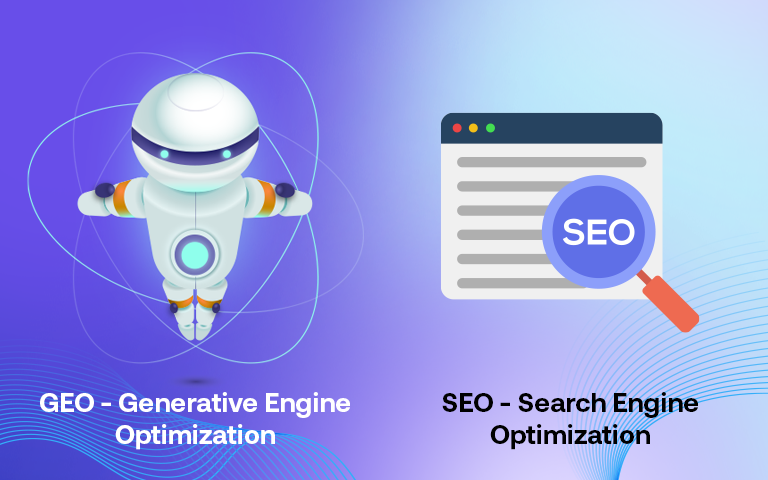
GEO vs SEO is a conversation about more than two approaches. It is a visibility architecture decision.
Search now operates across two connected experiences. Understanding GEO vs SEO begins with this shift: traditional search discovers and ranks pages, while generative search can interpret complex questions, break them into related information needs, retrieve supporting sources, synthesize evidence, and present an answer before a buyer visits a website.
That changes what an enterprise must optimize for.
SEO still determines whether critical content can be crawled, indexed, understood, and discovered. Generative Engine Optimization (GEO) adds another layer: whether the organization is sufficiently clear, authoritative, relevant, and retrievable to participate in AI-assisted discovery.
The strategic question is therefore not SEO or GEO? It is: How should enterprises redesign organic visibility when buyers can discover a ranked page, receive a synthesized answer, or move between both in the same research journey?
GEO vs SEO: The enterprise difference
The clearest distinction is the unit of visibility.
In SEO, the primary unit is usually the page: Can the right URL rank for the right demand?
In GEO, the unit expands to the information and entity ecosystem: Can AI systems retrieve useful passages, understand the organization behind them, connect its expertise to the prompt, and reference or represent that information appropriately?
| Enterprise consideration | SEO | GEO |
|---|---|---|
|
Demand intelligence
|
Keywords, search intent, SERP behavior |
Prompts, follow-ups, conversational and decision intent |
|
Primary visibility unit |
Ranked URL/page |
Retrieved information, citations, mentions and brand/entity representation |
|
Authority model |
Page/domain relevance and authority |
Topical authority plus entity clarity and external corroboration
|
|
Content architecture |
Pages mapped to search demand |
Topic ecosystems mapped to prompts, questions and buyer decisions |
|
Technical priority |
Crawl, index, render, internal architecture |
SEO foundations plus clear, retrievable and interpretable information |
|
Off-site influence |
Links, mentions, reputation
|
Links and mentions plus sources that corroborate brand expertise
|
|
Measurement |
Rankings, impressions, traffic, conversions |
Prompt visibility, citations, AI share of voice, representation, referrals and business impact |
SEO earns discoverability. GEO extends that discoverability into environments where machines increasingly participate in research, synthesis, comparison, and recommendation.
GEO vs SEO across discovery journeys
The enterprise impact of GEO vs SEO becomes clearer when we look beyond the search interface and examine how buyers actually discover and evaluate information.
Understanding how AI search makes decisions helps explain why enterprises increasingly need intent and topic ownership beyond individual keyword rankings. A traditional search program may map a high-value keyword to a landing page, strengthen that page, build supporting authority, and measure its position and commercial performance.
An AI-assisted journey can be more fragmented. A buyer may begin with a broad problem, narrow the requirements through follow-up prompts, request a comparison, introduce constraints, ask for implementation considerations, and finally investigate vendors.
The original prompt can therefore represent only the beginning of the demand.
For Google’s generative search experiences specifically, query fan-out can issue multiple related searches across subtopics and data sources before an AI response is assembled. That means enterprises need sufficient topical coverage and information depth to remain relevant beyond one exact query.
For enterprise leaders, the implication is significant: Keyword ownership remains valuable, but enterprises increasingly need intent and topic ownership around the decisions their buyers are trying to make.
What changes from SEO to GEO?
This is where the GEO vs SEO distinction becomes operational rather than theoretical.
1. From keywords to prompt intelligence
Enterprise SEO already studies search intent. GEO extends that intelligence into the questions, refinements, comparisons, constraints, and follow-up prompts buyers use during AI-assisted research. This requires a deeper AI prompt intelligence strategy that identifies the intent systems behind buyer questions rather than treating every prompt as an individual keyword.
Instead of optimizing only for enterprise procurement software, for example, the organization may need to understand prompts around integration requirements, vendor comparisons, implementation complexity, governance, ROI, security, and suitability for different enterprise environments.
This creates a prompt-to-intent map that reveals where the brand should participate across the buying journey, and where competitors currently own the conversation.
2. From content planning to decision intelligence
Publishing more content is not the objective.
Enterprises need a connected knowledge architecture that answers the questions AI-assisted buyers ask at different stages of evaluation. Pillar pages, cluster content, solution pages, comparisons, research, FAQs, case evidence, implementation guidance, expert perspectives, and commercial pages should reinforce one another.
The strategic shift is from “Which keyword needs a page?” to “What information must exist for our organization to be a credible source throughout this decision journey?”
That also means originality matters. First-hand expertise, proprietary data, research, customer evidence, frameworks, benchmarks, and informed perspectives create information value that commodity content cannot easily replicate.
3. From authority to entity confidence
Strong backlinks and domain authority remain valuable, but GEO introduces a broader question: Can AI systems confidently understand what your organization is authoritative about?
The answer is shaped by the consistency of brand, product, service, expert, industry, and topic relationships across the website and the wider web.
For enterprises, this makes entity strategy and external corroboration increasingly important. Industry coverage, expert contributions, authoritative mentions, relevant backlinks, reviews, associations, research citations, and consistent brand information can collectively reinforce what the organization claims about itself.
The website establishes the proposition. The wider digital ecosystem helps validate it.
4. From optimization to citation readiness
GEO does not require writing robotic content for machines. It requires making valuable information easy to locate, interpret, and use.
Important claims should be clear. Definitions should be precise. Comparisons should expose meaningful distinctions. Evidence should sit close to the statements it supports. Complex topics should have a strong hierarchy. Original research and expert insight should be attributable and understandable.
This improves the content for executive readers while also creating clearer information units for retrieval and synthesis.
For enterprises with thousands of pages, the opportunity is especially significant: GEO is as much an information-governance challenge as a content-writing challenge.
5. From rankings to AI visibility
An enterprise can hold strong organic positions and still have limited representation across important AI-assisted conversations.
GEO therefore introduces a second visibility layer. Teams need to understand which prompts surface the brand, which pages are cited, which third-party sources influence responses, how competitors are represented, where citation gaps exist, and whether AI visibility contributes to qualified visits and commercial outcomes.
The executive dashboard evolves from:
Rankings → Traffic → Leads
to a broader model:
Search Visibility + AI Visibility → Engagement → Influence → Pipeline
Where SEO ends and GEO extends
One of the most important conclusions from the GEO vs SEO comparison is that GEO should not be treated as a replacement for SEO.
For Google's AI search experiences, the technical foundation remains closely connected to Search: pages need to be accessible and eligible for indexing, while established practices around useful content, internal linking, page experience, structured data accuracy, and technical accessibility continue to matter.
GEO adds intelligence around areas that a conventional ranking program may not measure deeply enough.
| Keep strengthening through SEO | Extend through GEO |
|---|---|
|
Technical accessibility and indexability |
AI visibility and citation benchmarking |
|
Search intent and keyword demand |
Prompt, follow-up and buyer-intent intelligence |
|
Topic relevance and content quality |
Retrieval-ready, evidence-rich information |
|
Internal linking and site architecture |
Entity and knowledge relationships |
|
Backlinks and digital authority
|
Third-party corroboration and citation-source intelligence |
|
SERP and conversion performance |
AI mentions, citations, representation and share of voice |
This is why mature enterprises should resist creating completely separate SEO and GEO silos. The strongest model uses one intelligence system with different optimization and measurement layers.
The enterprise visibility gap
Consider an enterprise software company ranking strongly for its strategic commercial keywords.
Its SEO dashboard may show healthy positions, organic traffic, and branded demand. Yet when a procurement leader asks an AI platform to compare suitable providers against specific integration, security, geography, or deployment requirements, competitors may dominate the response, or the company may not appear at all.
That does not automatically mean its SEO strategy failed.
It reveals a visibility gap between ranking for known demand and participating in synthesized discovery. Closing this gap requires understanding how brands earn visibility and get mentioned in AI-generated answers across the wider digital ecosystem.
The gap may come from limited prompt coverage, weak entity relationships, insufficient third-party corroboration, content that lacks decision-stage evidence, or authoritative sources that consistently reinforce competitors instead.
For a high-value B2B purchase, missing from those early research and comparison moments can matter long before a prospect reaches a vendor website.
Turn the visibility gap into an enterprise advantage
Extend your search strategy across traditional and AI-powered discovery with Briskon.
Strengthen your GEO strategyOne connected visibility system
Enterprise teams do not need two disconnected content engines, one producing SEO content and another producing GEO content. They need a connected operating model.
1. Demand intelligence
Combine keyword data, SERP behavior, buyer research, prompts, follow-up questions, and commercial intent.
2. Visibility intelligence
Benchmark organic rankings alongside AI mentions, citations, source patterns, competitor visibility, and brand representation.
3. Authority architecture
Define the topics, entities, evidence, experts, external signals, and content ecosystems required to establish category authority.
4. Experience and conversion
Ensure the visibility earned across search ultimately leads buyers into relevant, persuasive experiences capable of progressing commercial intent.
This is where SEO, GEO, AEO, and CRO become more powerful when managed as connected disciplines rather than isolated tactics.
At Briskon, UnifiedOSS brings these disciplines into one connected organic search framework, aligning traditional search visibility, AI discoverability, answer optimization, and conversion intelligence around the complete buyer journey.
Allocating SEO and GEO investment
For enterprises evaluating GEO vs SEO investment, there is no universal percentage split.
The right allocation depends on how AI-assisted discovery is already influencing the category, the maturity of the SEO foundation, the complexity of the buying journey, current AI visibility, competitor presence, and the commercial value of the prompts where the brand is absent.
For most established enterprises, a sensible progression is:
Protect the SEO foundation. Preserve technical health, high-value rankings, authority, and conversion-performing organic assets.
Benchmark AI visibility. Establish where the brand, competitors, and third-party sources appear across commercially meaningful prompt sets.
Prioritize the gaps with business value. Focus GEO investment on topics and buyer journeys where visibility can influence evaluation, not every possible prompt variation.
Integrate execution. Use SEO, content, digital PR, entity optimization, technical improvements, and GEO measurement as a coordinated program.
This makes GEO an incremental intelligence and visibility layer, rather than a wholesale rebuild of the organic search function.
Evaluating an SEO and GEO partner
The quality of a GEO program becomes clearer through the questions a provider can answer.
Meaningful indicators of success include:
- Which commercially relevant prompts and buyer intents are we currently absent from?
- Which sources and competitors are consistently influencing AI responses in our category?
- Which content, entity, authority, or technical gaps are limiting our visibility?
- How will SEO and GEO priorities be integrated rather than duplicated?
- How will AI mentions and citations be connected to traffic, engagement, leads, and business impact?
An enterprise GEO strategy should produce decision intelligence, not simply screenshots showing that a brand appeared in an AI response.
When GEO becomes strategic
GEO deserves greater investment when AI is becoming part of how buyers research the category, compare providers, understand complex solutions, or build shortlists.
It becomes especially relevant for enterprises with high-consideration B2B sales, complex solution portfolios, long buying cycles, strong thought-leadership ambitions, or categories where authority materially influences vendor selection.
The starting point should be evidence: benchmark priority prompts, identify visibility and citation gaps, understand which sources shape the conversation, and determine where greater AI visibility could influence commercially valuable buyer journeys.
Briskon’s Generative Engine Optimization services apply this approach across prompt and intent intelligence, citation analysis, content and topical authority, entities, technical retrieval, digital authority, and AI visibility measurement.
Final thoughts
At boardroom level, GEO vs SEO should ultimately become a question of visibility architecture rather than competing marketing disciplines.
The better question is: Does our organization have the visibility architecture to remain discoverable throughout the modern buyer journey?
SEO remains essential because search engines still need to discover, understand, evaluate, and surface enterprise information. GEO matters because buyers increasingly encounter that information through AI-assisted research, synthesis, comparisons, and answers.
Enterprises that connect the two gain something more valuable than another marketing channel: A search ecosystem designed to build visibility from initial discovery through informed decision-making.
Build your advantage across search and AI
Turn SEO strength and GEO intelligence into a connected strategy for enterprise growth.
Contact us today