
ON THIS PAGE
- Overview
- The evolution from search rankings to AI reasoning
- Every AI answer begins long before the response
- The AI decision engine: How models evaluate information
- How AI builds confidence in organizations
- 1. Demonstrated expertise
- 2. Brand understanding
- 3. Digital trust
- 4. Content relevance
- 5. Technical intelligence
- 6. Contextual confidence
- Why AI may produce different answers for the same question
- From prompt to answer: The hidden decision pipeline
- 1. Interpret prompt
- 2. Identify context
- 3. Evaluate knowledge
- 4. Reason
- 5. Assess confidence
- 6. Generate answer
- The future of AI decision intelligence
Strengthen your visibility across AI-powered search


For years, digital visibility was largely defined by one question: "Where does my website rank?"
Today, AI-powered search is changing a much more fundamental aspect of digital discovery.
Instead of simply ranking webpages, platforms such as ChatGPT, Google AI Overviews, Gemini, Claude, Microsoft Copilot, and Perplexity interpret questions, evaluate information from multiple sources, and generate answers through a process of reasoning.
Every AI-generated response is the result of hundreds of micro-decisions that occur before a single word appears on the screen. User intent is interpreted, context is established, information is evaluated, competing knowledge is compared, and confidence is assessed before the final response is delivered.
Understanding this decision-making process is becoming increasingly important for organizations. It not only explains how AI generates answers, but also provides the foundation for Generative Engine Optimization (GEO). Businesses that understand how AI evaluates information are better positioned to strengthen their digital presence across AI-powered search experiences.
This evolution marks one of the most significant changes in search since the emergence of modern search engines and provides the foundation for understanding how digital discoverability is evolving in the AI era.
The evolution from search rankings to AI reasoning
Traditional search engines and generative AI platforms are designed to solve the same problem, helping users find information, but they approach that objective in fundamentally different ways.
Historically, search engines returned a ranked list of web pages based on hundreds of ranking factors. Users reviewed multiple websites, compared information, and decided which business best answered their needs.
Generative AI introduces a different experience.
Instead of presenting ten blue links, AI platforms analyze information from multiple trusted sources, understand the context of a user's question, and generate a conversational response that may recommend specific businesses, products, or services.
This changes the role of search from information retrieval to decision support.
For businesses, this means success is not measured by a webpage rank alone. It is increasingly influenced by whether AI platforms recognize the organization as a trusted, authoritative, and relevant source.
This evolution is reshaping digital marketing strategies across industries and making AI visibility an important component of long-term organic growth.
Every AI answer begins long before the response
One of the biggest misconceptions surrounding AI search is that answers begin when the model starts generating text.
In reality, every response begins much earlier.
Before AI retrieves knowledge, compares information, or constructs a response, it first attempts to understand the user's objective. The model evaluates the intent behind the prompt, identifies important entities, establishes contextual boundaries, and determines the type of answer that will best satisfy the request.
This interpretation stage is foundational to modern AI systems. Two prompts that appear almost identical may produce very different responses because the underlying intent differs.
For enterprise organizations, this represents an important shift. AI search is no longer processing keywords. It is interpreting business questions, evaluating context, and reasoning before generating an answer.
The AI decision engine: How models evaluate information
Unlike traditional search engines that primarily rank documents, modern AI systems evaluate information before generating responses.
Rather than selecting a single webpage, large language models compare multiple sources of knowledge simultaneously. Information is assessed for contextual relevance, semantic relationships, factual consistency, topical authority, and confidence before becoming part of the final response.
This decision process resembles reasoning more than retrieval.
Several factors influence that reasoning:
- Does the information directly answer the question?
- Is the topic consistently supported across multiple trusted sources?
- Does the response align with established knowledge?
- Can the information be explained with confidence?
Only after these evaluations are complete does AI generate the response presented to the user. The quality of an answer therefore depends not only on available information, but also on how effectively AI evaluates competing possibilities.
How AI builds confidence in organizations
One of the most common misconceptions about generative AI is that it simply retrieves information from the highest-ranking websites.
In reality, AI recommendation systems evaluate a much broader ecosystem of signals before generating responses. Rather than relying on a single ranking factor, AI platforms combine multiple layers of information to determine which businesses are most likely to provide accurate, trustworthy, and contextually relevant answers.
These signals work together. Strong content alone is rarely enough. Technical optimization without authority is equally limited.
Organizations that appear most frequently in AI-generated recommendations typically demonstrate strength across several interconnected dimensions. During its evaluation process, AI increasingly relies on several interconnected signals, including:
- Demonstrated expertise
- Brand entities
- Digital trust
- Contextual relevance
- Technical intelligence
- User experience
These signals do not operate independently.
Rather than evaluating each factor in isolation, AI combines them to build an overall level of confidence in an organization. Strength in one area rarely compensates for weaknesses in another. Instead, authority, trust, technical quality, contextual relevance, brand understanding, and user experience reinforce one another to shape how confidently AI interprets and evaluates a business.
The relationship between these interconnected signals can be visualized below.
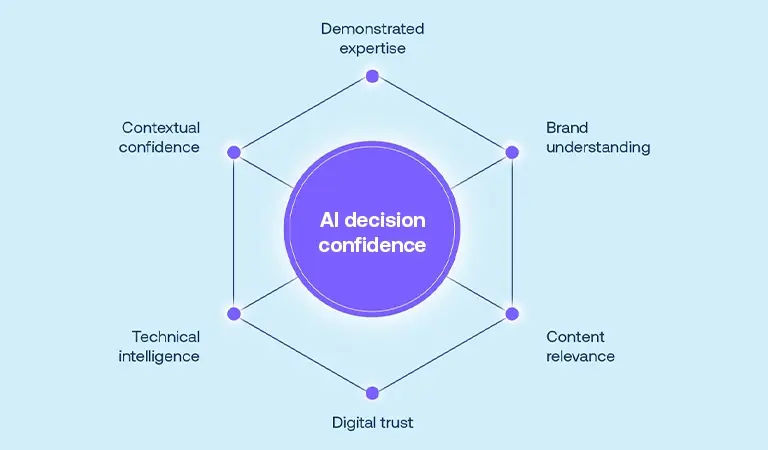
Let's explore each of these signals in greater detail.
1. Demonstrated expertise
The strongest signal AI platforms evaluate is expertise.
Generative AI aims to recommend organizations that consistently demonstrate deep knowledge within their area of specialization. Rather than relying on isolated webpages or individual blog articles, AI evaluates how comprehensively a business covers its subject matter across its entire digital presence.
Organizations that publish detailed, accurate, and experience-led content naturally build stronger topical authority over time. This makes it easier for AI platforms to understand what the business specializes in and when it should be recommended.
Expertise is demonstrated through consistency rather than volume. It grows when organizations continually expand their knowledge base with content that addresses customer challenges, industry trends, implementation strategies, best practices, and emerging technologies.
Signals that strengthen expertise:
- Comprehensive topical coverage
- Experience-led insights
- Original research and thought leadership
- Industry-specific knowledge
- Consistent publishing across related topics
As AI search continues to evolve, organizations that invest in genuine expertise are more likely to become trusted recommendations.
2. Brand understanding
Before AI can recommend a business, it must first understand what that business is, what it offers, and how it relates to other entities across the web.
This process extends beyond keywords.
Modern AI platforms build contextual relationships among organizations, products, services, industries, technologies, people, and locations through entities, commonly known as such.
Brand understanding is strengthened through consistent terminology, structured data, semantic relationships, internal linking, and knowledge graph optimization.
Organizations with well-defined digital entities reduce ambiguity and improve how AI interprets their business across different search experiences.
Signals that strengthen brand understanding:
- Entity optimization
- Knowledge graph development
- Structured data implementation
- Consistent brand information
- Semantic relationships across content
As AI becomes increasingly context-aware, organizations that clearly define their digital identity gain a significant visibility advantage.
3. Digital trust
Expertise alone does not automatically lead to recommendations. AI platforms also evaluate whether a business appears trustworthy.
Trust is built through multiple digital signals that reinforce credibility across the web. These signals may include authoritative mentions, industry recognition, reputable backlinks, expert authorship, consistent brand information, structured citations, customer validation, and overall digital reputation.
Rather than evaluating a single website in isolation, generative AI often considers the broader digital footprint surrounding an organization.
Businesses that are consistently referenced by trusted industry publications, partners, customers, and authoritative sources naturally strengthen their recommendation potential. Digital trust also grows when organizations maintain accurate, consistent, and reliable information across all digital channels.
Signals that strengthen digital trust:
- Authoritative citations
- Trusted industry mentions
- Strong brand reputation
- Consistent digital presence
- Experience-backed content
- Credible external references
In the era of AI-powered search, trust has become one of the strongest differentiators between organizations that are merely visible and those that are actively recommended.
4. Content relevance
AI evaluates relevance within the context of a user's objective rather than matching content solely through keywords. Organizations that answer business questions comprehensively and contextually provide AI with stronger signals for evaluation and reasoning.
Unlike traditional keyword matching, generative AI interprets natural language, understands intent, and identifies content that provides the most complete and meaningful response.
For example, consider two businesses offering Enterprise SEO services. One publishes a page optimized primarily for keywords. The other develops a connected knowledge ecosystem that answers customer questions, explains implementation strategies, compares approaches, discusses emerging trends, and demonstrates real-world expertise. Although both organizations may target similar keywords, AI is more likely to recommend the second because its content provides greater context and depth.
Content relevance is not determined by isolated webpages. It is influenced by how effectively your entire content ecosystem addresses the needs of prospective buyers throughout their decision-making journey.
Organizations that consistently publish comprehensive, well-structured, and user-focused content improve their ability to appear in AI-generated recommendations.
Signals that strengthen content relevance:
- Comprehensive topic coverage
- Conversational content structure
- Intent-focused content
- Clear information hierarchy
- Context-rich explanations
As conversational search becomes more prevalent, organizations that prioritize relevance over keyword repetition will be better positioned for long-term AI visibility.
5. Technical intelligence
Even the most authoritative content cannot influence AI recommendations if it cannot be efficiently discovered and interpreted. Technical optimization provides the digital foundation that enables AI platforms to understand your website with greater accuracy.
While technical SEO has traditionally focused on crawlability and search engine performance, technical intelligence extends this role by improving how AI systems interpret relationships between pages, entities, topics, and structured information.
A technically optimized website makes it easier for AI platforms to retrieve relevant information, understand contextual connections, and generate more accurate recommendations. Elements such as structured data, semantic HTML, internal linking, logical website architecture, and page performance all contribute to stronger AI understanding.
As websites become larger and more complex, technical intelligence becomes increasingly important for maintaining consistent AI visibility.
Signals that strengthen technical intelligence:
- Structured data implementation
- Semantic website architecture
- Internal linking strategy
- Crawlability and indexing
- Page performance and accessibility
Organizations that invest in technical excellence create a stronger foundation for both traditional search engines and AI-powered discovery.
6. Contextual confidence
One of the defining characteristics of generative AI is its ability to understand context.
Rather than recommending the same business for every search, AI evaluates the user's question, industry, objectives, and stage in the buying journey before determining which organization is most relevant.
A business may be highly authoritative in one domain yet less relevant in another. For example, an organization specializing in Enterprise SEO may be recommended for large-scale digital transformation projects but not necessarily for local SEO requirements. Similarly, a procurement software provider may appear in responses related to enterprise sourcing while not being recommended for retail point-of-sale solutions.
This contextual understanding enables AI to generate recommendations that are more closely aligned with the user's intent.
Organizations that clearly define their expertise, industries served, and areas of specialization make it easier for AI platforms to identify the situations where their business should be recommended.
Signals that strengthen contextual confidence:
- Industry specialization
- Clearly defined service offerings
- Consistent subject expertise
- Contextual content relationships
- Strong alignment with user intent
The more precisely AI understands what your organization does, and who it serves, the greater its confidence in recommending your business.
Why AI may produce different answers for the same question
One characteristic that distinguishes AI-powered search from traditional search is its ability to generate different responses to similar questions.
This variation is not necessarily inconsistent. It is a reflection of contextual reasoning.
Several variables influence the final response:
- Prompt phrasing
- Previous conversation
- Geographic context
- Industry terminology
- Model architecture
- Confidence in available information
As a result, AI does not simply retrieve identical answers. It continuously adapts responses based on changing context while maintaining factual alignment wherever possible.
For enterprise decision-makers, this highlights why AI search should be viewed as a reasoning system rather than a static search engine.
From prompt to answer: The hidden decision pipeline
Every AI-generated response follows a structured decision-making process before reaching the user. Rather than retrieving a single source, AI interprets intent, evaluates context and knowledge, reasons across multiple possibilities, and assesses confidence before generating an answer.
This connected sequence explains why AI-powered search is fundamentally different from traditional search and why every response is shaped by far more than keyword matching.
The AI decision pipeline can be summarized in six connected stages.
1. Interpret prompt
AI begins by understanding the user's objective, identifying intent, key entities, constraints, and the type of response expected.
2. Identify context
The model establishes the broader context by recognizing industries, relationships, previous conversation, geography, and domain-specific terminology.
3. Evaluate knowledge
Relevant information is assessed for authority, relevance, factual consistency, completeness, and contextual alignment.
4. Reason
Rather than selecting a single source, AI compares multiple perspectives, resolves inconsistencies, and synthesizes the most appropriate response.
5. Assess confidence
Before generating an answer, the model evaluates how reliable and contextually appropriate the response is based on the available information.
6. Generate answer
Only after completing these evaluations does AI produce a natural language response aligned with the user's intent and context.
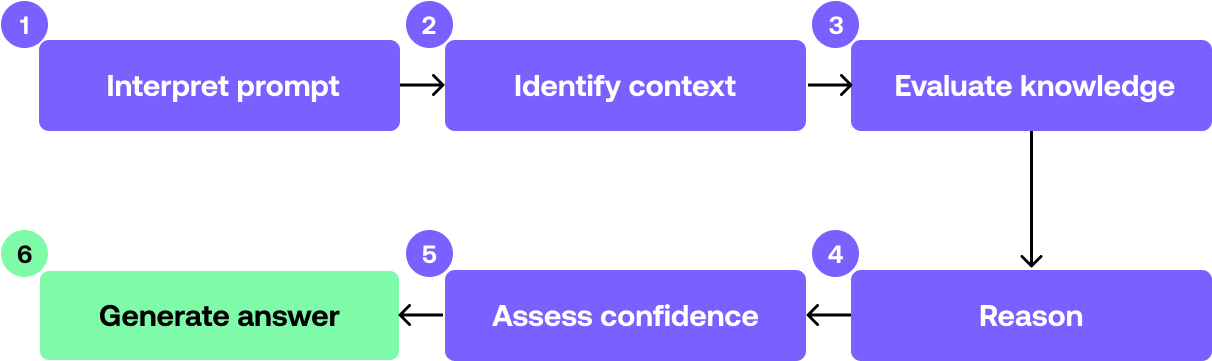
Understanding this decision pipeline explains why Generative Engine Optimization (GEO) has become increasingly important. GEO aligns content quality, technical foundations, digital entities, authority, and trust with the way AI platforms interpret, evaluate, and generate responses, helping organizations strengthen their discoverability across AI-powered search.
The future of AI decision intelligence
Artificial intelligence is evolving beyond information retrieval. Increasingly, it is becoming a reasoning system capable of interpreting complex questions, evaluating competing information, and supporting enterprise decision-making.
Future AI systems will increasingly demonstrate deeper reasoning, greater contextual awareness, stronger source attribution, and improved transparency around how answers are generated.
Enterprise users will ask increasingly sophisticated questions involving comparisons, evaluations, trade-offs, implementation guidance, and strategic recommendations.
As these capabilities mature, organizations will benefit from understanding not only what AI answers, but how those answers are constructed.
The future of AI search will be defined as much by reasoning quality as by information availability.
Frequently asked questions
How does AI decide what information to include in an answer?
Why does AI give different answers to similar questions?
Does ranking first on Google guarantee visibility in AI search?
How is AI search different from traditional search engines?
Why is understanding AI decision-making important for Generative Engine Optimization (GEO)?
Shape how AI understands your business
Build long-term discoverability with Briskon
Contact us today
