Win the committee before the first sales call.


Most B2B SEO strategies target one buyer. Most B2B deals are decided by many
Forrester's The State of Business Buying, 2026, based on a survey of nearly 18,000 business buyers, found that, on average, 13 internal stakeholders and nine external participants influence a purchase. Procurement now acts as a decision-maker in 53% of buying cycles. Each person searches for different answers at different moments, with different reasons to say no.
An effective B2B SEO strategy for long sales cycles therefore maps keywords by role and buying stage. Every stakeholder who researches the purchase should find a page that answers their specific question. Together, those pages should give your internal champion the material to build consensus.
This guide shows how to build that map, which content formats move a committee forward, and how to measure SEO when the sales cycle runs for quarters rather than weeks.
Executive takeaways
- Funnel-stage keyword research is incomplete for committee purchases. A CFO, a security lead, and an end user evaluating the same product search for entirely different things.
- Low-volume queries from approvers and veto holders often carry the highest commercial value. Score keywords by role influence, not search volume alone.
- Consensus content is a distinct asset class. Business cases, security documentation, implementation plans, and procurement FAQs help a champion sell internally.
- AI search adds a validation layer. Buyers use AI to research, then check its answers against trusted sources. Clear, citable, role-specific pages serve both steps.
- Measure coverage and account-level engagement, not just rankings. Long cycles demand leading indicators tied to the pipeline.
Why single-persona B2B SEO strategies stall long sales cycles
Traditional keyword research groups queries by topic and funnel stage: awareness, consideration, decision. That model assumes one buyer moving in a straight line. Committee purchases do not work that way.
B2B purchases involve overlapping buying jobs, from problem identification and solution exploration to supplier selection, and different stakeholders work on them at the same time. Increasingly, they do that work themselves. A March 2026 Gartner survey of B2B buyers found that 67% prefer a rep-free buying experience and 45% used AI during a recent purchase. The same research stresses that buying groups need value clarity: an understanding of how a solution improves outcomes in each buyer's specific role and business context. Much of that work happens in independent research and internal alignment, where search plays a central role.
Three problems follow when SEO targets a single persona:
- Coverage gaps where vetoes happen. A security reviewer or procurement lead who finds nothing relevant on your site will rely on a competitor's documentation or on assumptions.
- Inconsistent information across the committee. When each stakeholder pieces together a different picture, consensus takes longer. Deals stall in internal debate rather than in vendor evaluation.
- Misleading performance data. A strategy built around high-volume informational terms can grow traffic while budget approvers never reach the site.
The fix is structural: treat the buying committee, not the individual, as the unit your B2B SEO strategy serves.
The buying-committee keyword map: A role-by-role framework
A buying-committee keyword map is a planning matrix that assigns search queries to each stakeholder role and buying job. It then pairs each query cluster with the content asset that answers it and the next action that moves the deal forward.
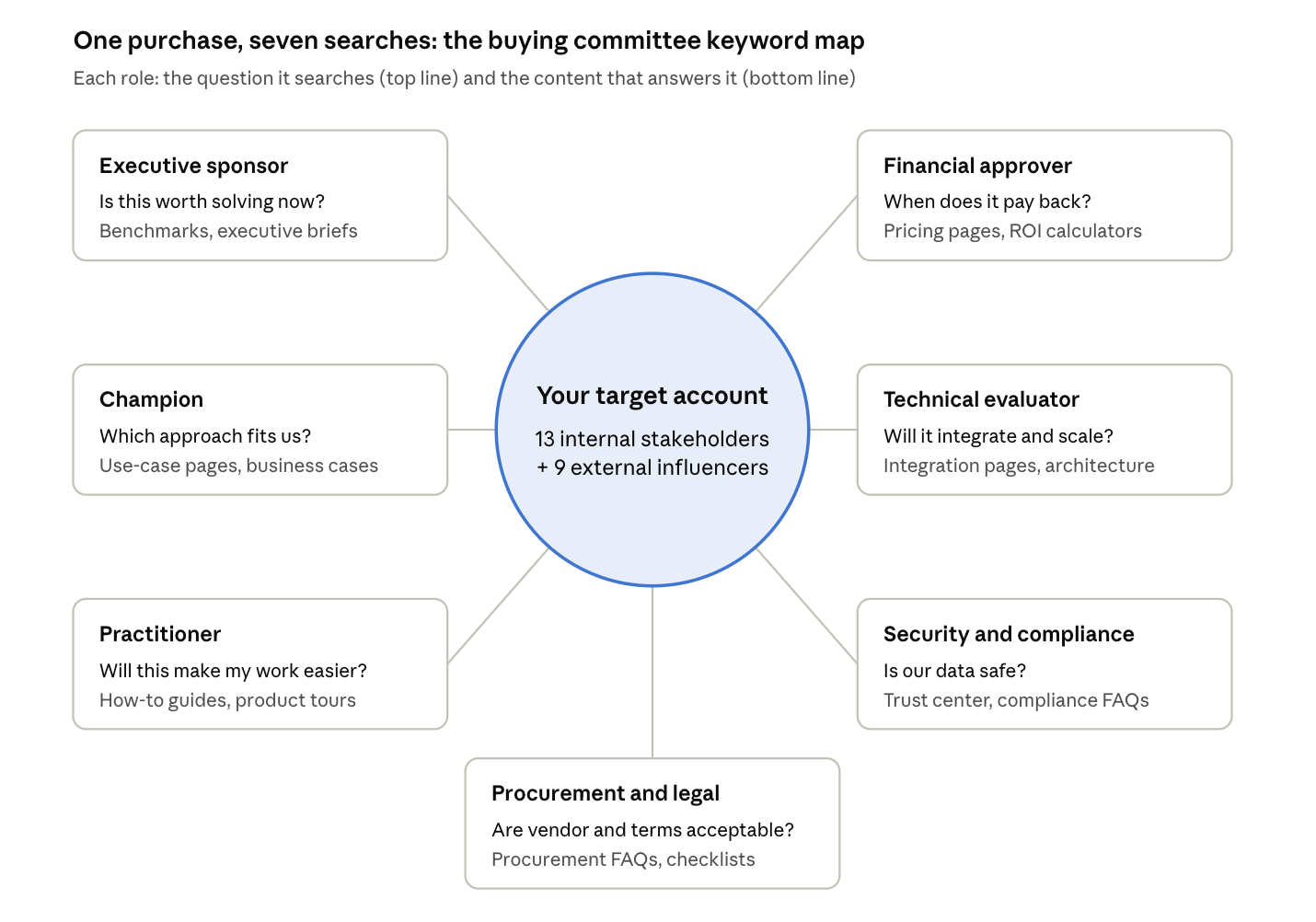
At a glance: Executives need benchmarks, champions need business cases, practitioners need how-to guides, finance needs ROI and pricing pages, IT needs integration details, security needs a trust center, and procurement needs vendor FAQs and checklists.
Two principles make the map work. First, every role needs at least one indexable page that answers its core question. Second, those pages must link to each other, because committee members share links internally. A champion who forwards your ROI page to the CFO should find that the CFO can easily reach your security and implementation pages next.
Six steps to build a B2B SEO strategy around the buying committee
1. Reconstruct the committee from real deals
Start with evidence, not personas. Review recent closed-won and closed-lost opportunities. Record which roles appeared in each deal, when they entered, and who raised objections. The most reliable sources are CRM contact roles, call recordings, and win/loss interviews. Committee makeup varies by deal size and industry, so build separate maps where those patterns differ.
2. Capture each role's questions in their own words
CFOs rarely search the way product marketers write. Collect real phrasing from sales calls, RFP questions, security questionnaires, support tickets, and Google Search Console query reports. People Also Ask results and the questions prospects say they asked AI assistants are useful additions. The goal is a role-based question bank.
3. Cluster queries by role and buying job
Group questions into clusters that share search intent, then tag each cluster with a role and a buying job. A cluster such as "integration with SAP" belongs to the technical evaluator during requirements building. A cluster such as "ROI of e-sourcing" belongs to the financial approver during validation. This two-axis tagging exposes gaps that a topic-only view hides.
4. Prioritize by commercial value, not volume
Score each cluster on four factors:
- Role influence: Does this person approve, veto, or merely inform?
- Proximity to decision: How close is the buying job to vendor selection?
- Competitive gap: Do competitors answer this question well?
- Demand: How many people search for it?
A low-volume query from security reviewers at target accounts can matter more than a high-volume informational term. Weight the score toward role influence when your sales team reports late-stage stalls.
5. Assign one primary page per cluster
Give every cluster a single target page to avoid cannibalization. Organize pages into hubs: a pillar page for the solution, supported by role-specific pages for pricing, security, integrations, implementation, and use cases. Clear internal linking helps search engines understand relationships and helps committee members move between the answers they need.
6. Build paths between roles
Design each page with the next stakeholder in mind. An ROI page can link to implementation timelines. A security page can link to the procurement FAQ. Shareable, ungated assets such as one-page business cases and evaluation checklists make it easy for a champion to circulate your content inside the buying group.
Consensus content: The formats that move a committee forward
Role-specific pages answer individual questions. Consensus content helps the group agree. This matters because buyers value larger groups for lowering risk and securing budget, and they want proof before they commit.
The following formats earn search visibility and support internal selling:
- Business-case templates. Give champions a structure they can adapt for leadership, with your category's value drivers already defined.
- ROI and total-cost calculators. Let finance stakeholders test assumptions with their own numbers.
- Security and trust center pages. Answer compliance questions publicly so security reviews start informed, not skeptical.
- Implementation and onboarding plans. Show realistic timelines, resource needs, and milestones to reduce perceived delivery risk.
- Honest comparison pages. Explain where your approach fits and where alternatives may suit better. Credibility with evaluators depends on balance.
- Pilot and trial guides. More than 60% of business buyers now purchase some form of trial, so pages that explain how a pilot works and how success is measured serve that stage.
- Procurement FAQs. Cover contract structure, support terms, data handling, and vendor information that procurement teams request early.
These assets also strengthen high-intent, decision-stage search visibility, where Briskon's B2B SEO services focus on solution, use-case, comparison, and vendor-evaluation searches.
B2B SEO best practices for AI-assisted committee research
AI assistants are now part of how buying committees research vendors. Yet buyers rarely take AI answers at face value. They validate them against peers, product experts, and analysts, because AI answers can be incomplete or unreliable.
That creates two jobs for your content: be clear enough for AI systems to interpret accurately, and credible enough to survive validation.
These practices support both:
- Write self-contained answers for each role. A security page should answer security questions fully without assuming the reader has seen your homepage.
- Lead with direct answers. Open key sections with a one- or two-sentence answer, then add detail. This helps human skimmers and answer engines alike.
- Keep entities consistent. Use the same names for your products, features, integrations, and industries across every page.
- Use structured data where it fits. Organization, product, FAQ, and article markup add machine-readable context. Markup improves eligibility for enhanced results, but search engines decide what to display.
- Earn third-party validation. Analyst mentions, review platforms, partner listings, and expert commentary give buyers and AI systems independent sources that confirm your claims.
These practices align with answer engine optimization (AEO) and generative engine optimization (GEO). Neither guarantees inclusion in AI-generated answers, but both make your content easier to find, interpret, and trust.
Measuring B2B SEO performance across a long sales cycle
Rankings and sessions lag and are incomplete signals when deals take several quarters to close. A committee-based strategy needs metrics that show whether the right people are engaging before revenue appears.
| Metric | What it tells you | Where to find it |
|---|---|---|
| Role coverage | Share of committee roles with a ranking, indexed page for their core question | Keyword map plus rank tracking |
| Role-page engagement | Whether finance, IT, security, and procurement pages attract qualified visits | Web analytics, segmented by page group |
| Account-level engagement | Whether several people from the same target account visit different role pages | First-party data, account identification, or ABM platforms |
| Organic-influenced opportunities | How many open deals included organic touchpoints before or during evaluation | CRM with multi-touch attribution |
| Stage velocity | Whether deals with organic engagement move between stages faster | CRM opportunity history |
| Sales-qualified leads from organic | Volume and quality of organic conversions that sales accepts | CRM and marketing automation |
Report these on a cadence that matches your sales cycle. Quarterly pipeline reviews usually reveal more than weekly ranking reports. Attribution will never be perfect in committee buying, so treat influenced-pipeline figures as directional evidence rather than precise credit. Frameworks such as Briskon's UnifiedOSS connect search, AI visibility, and conversion signals in one view.
Example: Mapping keywords for a procurement software purchase
The following scenario is hypothetical and illustrates the method.
A US software vendor sells an e-sourcing and reverse auction platform to mid-market manufacturers. Its current B2B SEO strategy targets terms such as "e-sourcing software" and "reverse auction software." Traffic is steady, but sales reports that deals stall after the demo.
Win/loss interviews show a consistent pattern. The procurement director champions the purchase, but the CFO questions payback, IT asks about ERP integration, and the legal team raises data-handling concerns. None of those roles finds relevant answers on the vendor's site.
The keyword map closes the gaps:
| Role | Query cluster (illustrative) | New or updated page |
|---|---|---|
| Champion (procurement director) | "how to run a reverse auction", "reverse auction best practices" | Practical playbook linking to the business-case template |
| Financial approver (CFO) | "e-sourcing ROI", "reverse auction cost savings" | ROI explainer with a calculator and transparent assumptions |
| Technical evaluator (IT) | "e-sourcing ERP integration", "e-sourcing SAP integration" | Integration overview with supported systems and data flows |
| Legal and security | "e-sourcing data security", "supplier data privacy" | Trust center page covering data handling and compliance |
| Executive sponsor (COO) | "procurement cost reduction strategies" | Executive brief on sourcing strategy and risk |
The vendor would measure success by role coverage, account-level engagement with the new pages and late-stage stall rates, rather than by total traffic alone.
Trade-offs to weigh before you commit resources
A committee-based SEO for B2B strategy requires more from the content team.
Leaders should plan for these trade-offs:
- Smaller traffic numbers. Many role-specific queries have modest volume. Set expectations with leadership that value per visit matters more than visit count.
- Subject-matter input. Security, finance, and integration pages need review from internal experts. Budget their time from the start.
- Maintenance. Pricing, compliance, and integration details change. Assign owners and review dates so pages stay accurate.
- Gated versus ungated assets. Gating a business-case template captures leads but slows internal sharing. Many teams ungate consensus assets and gate deeper tools.
- Sequencing. Covering every role at once is rarely realistic. Start with the roles most often linked to late-stage stalls, then expand.
Final thoughts
Long B2B sales cycles rarely stall because buyers lack information. They stall because each committee member holds a different piece of it. A B2B SEO strategy built around the buying committee closes that gap. It gives every role a credible answer to its own question, connects those answers into one coherent case, and measures progress by account engagement and pipeline rather than traffic alone. Start with the roles that most often slow or block your deals, prove the impact over one full sales cycle, and expand from there.
Frequently asked questions
What is a B2B SEO strategy?
A B2B SEO strategy is a plan for earning organic search visibility with the business buyers who research, evaluate, and approve your product or service. It combines search-demand research, technical SEO, content, authority building, and conversion paths, and it measures success by qualified pipeline rather than traffic alone.
How does SEO strategy for B2B differ when sales cycles are long?
Long cycles involve more stakeholders, more research, and more internal debate. SEO must therefore cover several roles and buying jobs, support consensus-building, and be measured with leading indicators such as role coverage and account engagement, because revenue appears months after the first search.
How many buying committee roles should a keyword map cover?
Cover every role that regularly approves, vetoes, or significantly shapes the decision in your deals. For most B2B technology purchases, that includes the business sponsor and end users, plus finance, IT, security, and procurement. Start with the roles most associated with stalled or lost deals.
Should a B2B SEO strategy target low-volume keywords?
Yes, when those keywords come from influential roles close to a decision. A query about security compliance or ERP integration may have little volume but high commercial value. Balance them with broader terms that build category visibility and attract new accounts.
How long does B2B SEO take to influence the pipeline?
Timelines depend on your site's authority, competition, and sales-cycle length. New pages typically need time to index and gain visibility, and the deals they influence then need a full cycle to close. Track leading indicators quarterly and assess pipeline impact over at least one complete sales cycle.
How can we measure SEO impact when several stakeholders are involved?
Combine page-group analytics with account-level data. Track whether multiple people from target accounts engage with different role pages, then use CRM multi-touch attribution to see which opportunities included organic touchpoints. Treat the results as directional, since committee buying rarely has one clear source.
What are the most important B2B SEO best practices for AI search?
Publish clear, self-contained answers for each role, use consistent names for products and entities, add relevant structured data, and earn credible third-party mentions. These steps make content easier for AI systems to interpret and for buyers to validate, though no practice guarantees inclusion in AI-generated answers.
Does a buying-committee approach replace account-based marketing?
No. It complements ABM. ABM targets known accounts through outbound and paid channels, while committee-based SEO ensures every role at those accounts finds useful answers when they search independently. Together they cover both the conversations you start and the research buyers do on their own.
Win the committee before the first sales call.
Briskon's B2B SEO helps you reach every member.
Contact us today