A better RFP gets better proposals.


A weak SEO RFP produces weak proposals. When the request lists tasks instead of goals, agencies respond with keyword counts, blog quotas, and ranking promises that are easy to compare and hard to trust.
A strong SEO RFP does the opposite. It explains the business outcome you need, shares enough data for vendors to diagnose your situation, and asks them to show their reasoning. It also tells every bidder, in advance, exactly how you will score their response.
This guide gives you a section-by-section SEO RFP template, a scoring framework your marketing and procurement teams can share, and the red flags that should remove a proposal from consideration.
Executive takeaways
- Write the RFP around outcomes, not deliverables. Ask vendors to propose the work that will move pipeline or revenue, rather than pricing a fixed list of tasks.
- Share data before you ask for strategy. Read-only access to analytics and Search Console lets serious agencies give specific answers instead of generic ones.
- Publish your scoring criteria. Vendors write better proposals when they know what matters, and your evaluators stay consistent.
- Treat guarantees as disqualifiers. No vendor controls search rankings, so a proposal that promises a top position has already told you something important.
- Test thinking, not just credentials. A short, scoped exercise or a finalist workshop reveals more than any capabilities deck.
What an SEO RFP is and when you need one
An SEO RFP (Request for Proposal) is a formal document that invites agencies or consultants to propose how they would meet your search goals, and at what cost. It standardizes what each vendor receives, so your team can compare responses on the same terms.
An RFP is not always the right tool. Use the format that matches how much you already know:
| Document | Use it when | What you get back |
|---|---|---|
| RFI (request for information) | You are still defining the problem and want to learn what vendors offer | Capabilities, approaches, and indicative pricing |
| RFP (request for proposal) | You know the goal and constraints and want a tailored strategy | A diagnosis, plan, team, timeline, and price |
| RFQ (request for quote) | The scope is fixed and well defined, such as a technical audit | A price for a defined deliverable |
Many organizations run these in sequence as part of broader RFx management: an RFI to build a shortlist, then an RFP for the finalists. For a one-off project with a clear scope, such as a site migration, an RFQ may be enough.
Prepare these inputs before you write the SEO RFP
Proposal quality depends on the quality of what you share. Most of the effort in a good SEO services RFP happens before anyone writes the document.
- Agree on the business goal internally. Marketing, sales, finance, and IT should align on what success means, whether that is a qualified pipeline, revenue from organic search, or recovery from a traffic decline. Formal requirements gathering at this stage prevents scope changes mid-process.
- Document the baseline. Summarize current organic traffic trends, top-performing pages, conversion rates, and known technical issues. Vendors cannot propose realistic improvements without a starting point.
- Prepare read-only data access. Plan to give shortlisted vendors restricted access to Google Search Console and your analytics platform. Search Console lets property owners add users with different permission levels, so you can share data without handing over control.
- Map your constraints. Note your CMS, development release cycles, legal review requirements, and content approval workflow. These shape what any vendor can realistically deliver.
- Set a budget range. Sharing a range saves time for both sides and lets vendors tailor proposals to what you can fund.
- Name the evaluation team. Decide who scores proposals and who makes the final decision before the RFP goes out.
SEO RFP template: Ten sections to include
Use the template below as a starting structure. Each section explains what to include and lists questions vendors must answer. Keep the questions open-ended, because you're evaluating how a vendor reasons through them.
1. Company overview and context
Describe what you sell, who buys it, your main markets, and your key competitors in search. Include anything that makes your situation unusual, such as a recent rebrand, a regulated industry, or a planned re-platform.
2. Business goals and success metrics
State the outcome you need and how you will judge it. Tie goals to business KPIs such as qualified leads, pipeline, or revenue, rather than rankings alone.
Ask vendors:
- Which leading indicators would you track to show progress before revenue appears?
- How would you connect organic performance to our CRM data?
3. Current state and known challenges
Share your baseline data summary, recent traffic changes, past SEO work, and known technical SEO issues. Honesty here produces sharper proposals.
Ask vendors:
- Based on the data provided, what do you see as our three most important problems or opportunities?
- What additional information would you need to confirm that diagnosis?
4. Scope of work
List what is in scope, what is out of scope, and what is optional. Typical workstreams include technical SEO, content strategy and production, link building, digital PR, conversion optimization, and visibility in AI-generated answers through AEO and GEO.
Ask vendors:
- Which of these workstreams would you prioritize first, and why?
- What would you recommend we exclude or defer?
5. Data, access, and tools
Explain which platforms vendors will receive access to and at what permission level. State who will own all accounts, reports, and content produced during the engagement.
Ask vendors:
- What access do you need at each stage, and how do you protect client credentials?
- Which tools do you use, and what are their limitations?
6. Approach and methodology
This is the heart of the RFP. Ask vendors to explain how they would work, not just what they would deliver.
Ask vendors:
- Walk us through your plan for the first quarter of the engagement.
- How do you decide what to prioritize when resources are limited?
- How do your recommendations align with official search engine guidance?
- How do you adapt when a core algorithm update affects performance?
7. Team, governance, and communication
Ask for the names and roles of the people who will actually do the work, not just those who pitch it. Ask how decisions, approvals, and escalations will flow, and how often you will meet, such as in quarterly business reviews.
Ask vendors:
- Who leads our account day-to-day, and what is their relevant experience?
- How do you handle work that needs our developers or legal team to approve?
8. Reporting and measurement
Define what reports you expect and how often. Ask for a sample report from a comparable engagement, with client details removed. Strong vendors explain their tracking and attribution approach clearly.
Ask vendors:
- What does your standard monthly report include?
- Will we have direct access to dashboards, or only to summaries?
9. Pricing and commercial terms
Ask for pricing that maps to the proposed scope, so you can see what each dollar buys. Invite vendors to propose the engagement model they recommend. For example, Briskon prices its B2B SEO services through fixed retainer, performance-linked, and dedicated team models.
Ask vendors:
- What is included in the price, and what would cost extra?
- What are the contract term, notice period, and exit terms?
10. Submission instructions and timeline
Set dates for vendor questions, submission, finalist presentations, and the decision. Specify the format, a page limit if you want one, and a single point of contact. Publish your evaluation criteria here, too.
How to run the SEO RFP process from start to finish
The RFP document is one step in a longer selection process. Planning every stage up front keeps the timeline realistic and the comparison fair.
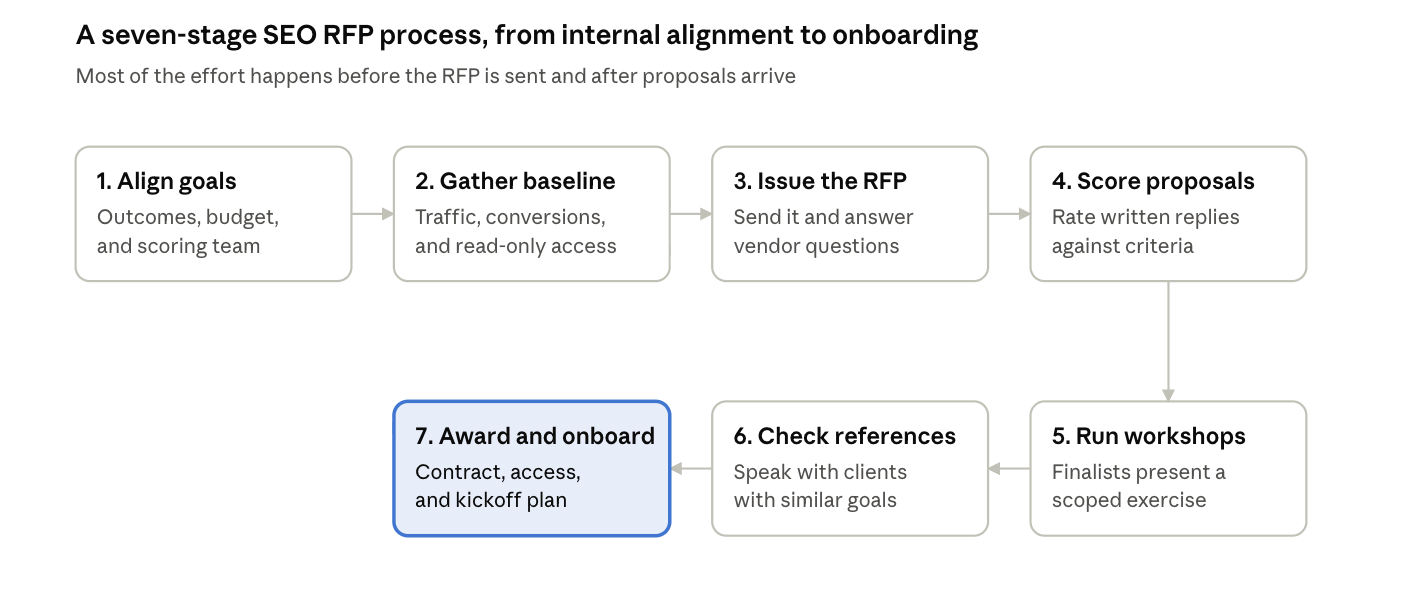
At a glance: Align goals and evaluators, gather baseline data, issue the RFP and answer questions, score written proposals, run finalist workshops, check references, then award the contract and start onboarding.
Two stages deserve extra attention. Answer vendor questions in a single shared document so every bidder works from the same information. In finalist workshops, give each agency the same short, scoped exercise, such as reviewing one underperforming page. Comparing how finalists think through a real problem is more revealing than comparing slide decks.
SEO RFP evaluation criteria: How to score proposals fairly
A shared scoring rubric turns a subjective debate into a structured decision. Agree on the criteria and their relative weight before proposals arrive, so no one adjusts the rules to favor a preferred vendor.
| Criterion | What a strong response shows | Priority |
|---|---|---|
| Diagnosis of your situation | Specific observations drawn from the data you shared, not generic best practices | High |
| Strategy and prioritization | A clear rationale for what comes first, with trade-offs explained | High |
| Business alignment | Goals tied to pipeline or revenue, and a credible plan to measure them | High |
| Team and experience | Named practitioners with relevant industry and technical experience | High |
| Compliance with search guidelines | Methods that follow official search engine guidance, explained in plain language | High |
| Reporting and transparency | Sample reports, direct dashboard access, and clear change logs | Medium |
| AI search readiness | A grounded approach to visibility in AI-generated answers, without guarantees | Medium |
| Pricing clarity | Costs mapped to scope, with exclusions and exit terms stated | Medium |
| Cultural and working fit | Responsiveness, curiosity about your business, and realistic expectations | Medium |
Three practices keep scoring consistent:
- Score independently first. Each evaluator rates every proposal alone, then the group compares scores and discusses gaps. This limits the loudest voice's influence.
- Use a consistent scale with written definitions. Define what a low, middle, and high score means for each criterion, so evaluators interpret them the same way.
- Separate price from quality. Score the strategy and team before anyone looks at pricing. Otherwise, a low price can make a weak proposal look better than it is.
Example: Comparing two SEO proposals
The following comparison is hypothetical and illustrates the scoring method.
A B2B software company receives two finalist proposals. On the surface, Proposal A looks more attractive: it is cheaper and promises more content.
| Criterion | Proposal A | Proposal B |
|---|---|---|
| Diagnosis | Generic audit checklist; no reference to the company's data | Identifies indexation problems on key product pages from the shared Search Console data |
| Strategy | Fixed monthly blog quota | Fixes technical blockers first, then builds pages for high-intent queries |
| Measurement | Keyword rankings and traffic | Qualified leads and pipeline influenced by organic search |
| Team | Senior strategist named for the pitch only | Named day-to-day lead with relevant B2B experience |
| Red flags | Promises first-page rankings for priority terms | None identified |
Proposal B wins on every high-priority criterion. Proposal A's ranking promise alone would justify removing it from consideration, as the next section explains.
Red flags in SEO proposals that should end the conversation
Some answers tell you more than an entire proposal. Google's own guidance on hiring an SEO is clear: "No one can guarantee a #1 ranking on Google." The same guidance names several other warning signs that belong in every evaluator's checklist.
- Ranking guarantees or claimed insider access. Treat any promise of a specific position, a claimed special relationship with a search engine, or a paid priority-submission service as disqualifying.
- Secrecy about methods. A vendor that will not explain what it plans to change, or why, is asking you to accept a risk you cannot see. You remain responsible for the actions of any agency you hire.
- Link schemes and mass submissions. Proposals that rely on buying links, requiring you to link back to the agency, or mass-submitting your site to directories point to tactics that violate search spam policies and can harm your visibility.
- Requests for full control during evaluation. An audit needs read access to your data, not the ability to change your site or your Search Console settings. Grant write access only after contract signature, with a clear change log.
- "Approved" or proprietary tools presented as an advantage with search engines. Search engines do not endorse third-party SEO tools, and those tools have no access to internal ranking data. A vendor that implies otherwise is overselling.
- Guaranteed visibility in AI answers. No vendor controls which sources AI systems cite. Strong proposals describe how they will improve your content's clarity, authority, and structure, and how they will track results.
- Unsolicited outreach that claims you are invisible. Cold emails warning that your site is missing from search engines are a sales tactic, not a diagnosis.
- A pitch team that disappears after signature. If the presenters won't work on your account, ask to meet the actual team before you decide.
- Ownership terms that favor the vendor. You should own your accounts, content, data, and reporting dashboards outright, including after the contract ends.
- Reporting built on vanity metrics. A proposal that measures success only in rankings or raw traffic will struggle to show business impact.
One red flag can be a misunderstanding. Several in the same proposal form a pattern worth taking seriously.
Questions to ask finalists in the presentation round
Written proposals show what a vendor can prepare. Live conversations show how they think. Use these questions in finalist workshops:
- What would you stop doing on our site, and why?
- Tell us about an engagement that did not go as planned. What did you change?
- If organic traffic dropped sharply after a core update, what would you check first?
- Which recommendation in your proposal carries the most risk, and how would you manage it?
- What do you need from our team for this engagement to succeed?
The best answers are specific, candid about limits, and grounded in your data rather than a standard playbook. For a broader vetting checklist beyond the RFP, see how to choose the right SEO consulting company.
Final thoughts
An SEO RFP is more than a procurement formality. It is the first piece of strategy work in the engagement. When you define outcomes clearly, share real data, and publish how you will score responses, you attract agencies that think rather than agencies that sell. Build your RFP around the SEO RFP template above, score every proposal against the same criteria, and remove any vendor that relies on guarantees or secrecy. The partner you choose will then start from a shared understanding of what success looks like.
Frequently asked questions
What should an SEO RFP include?
It should include a company overview, business goals and success metrics, a summary of current performance, the scope of work, data access terms, questions about approach and methodology, team and reporting requirements, pricing instructions, and the submission timeline. It should also explain how you'll evaluate proposals.
How long should an SEO RFP be?
Long enough to give vendors the context they need, and no longer. Most of the value comes from clear goals, baseline data, and focused questions. Setting a page limit for responses helps evaluators compare proposals and pushes vendors to prioritize.
How many agencies should receive your RFP?
Send it to a short list of agencies that have already passed an initial screen for relevant experience. A long list increases evaluation work without improving the outcome, and strong agencies may decline RFPs that seem like broad price-shopping exercises.
Should we share our budget in the RFP?
Yes, at least as a range. A budget range lets vendors propose a realistic scope instead of guessing, making proposals easier to compare and saving time for everyone involved.
What is the difference between an SEO RFP and an SEO audit?
An RFP asks vendors to propose how they would work with you over time. An SEO audit is a defined piece of work that diagnoses your site's current issues. Some companies run a paid audit as a final evaluation step, which lets them assess a vendor's work before committing to a longer engagement.
Can an SEO agency guarantee results?
No agency can guarantee specific rankings, because no one outside a search engine controls its ranking systems. Agencies can commit to clear deliverables, transparent reporting, and a measurement plan tied to your business goals.
Should an SEO RFP cover AI search visibility?
Yes. Buyers increasingly research through AI-generated answers as well as traditional results. Ask vendors how they approach AI search visibility, how they measure it, and how their methods align with official search engine guidance, and treat any guaranteed AI citations as a red flag.
Hire the right SEO partner the first time
Briskon’s SEO consulting helps you set clear goals, scope, and metrics.
Contact us today.